Over decades of experience in aromatic carboxylic acid synthesis, the evolution of 3,5-dimethylbenzoic acid reflects broad trends in chemical manufacturing. The early focus on benzoic acid derivatives in the late 1800s set the groundwork for selectivity in alkyl group introduction. In the mid-20th century, as researchers explored substitution on the benzoic acid core, chemists identified that the methyl groups at the 3 and 5 positions offered a surprising robustness during further manipulation. Factories adjusted batch processes to accommodate mild oxidations rather than risk excessive side reactions with strong agents. By the 1970s, analytical tools such as NMR and gas chromatography made it possible to confidently distinguish between dimethyl isomers, shaping quality standards that persist. These historical roots still influence our batch design and allow us to maintain tight controls in each step of manufacture.
3,5-Dimethylbenzoic acid earns its place not for its volume, but for its reliability in specialty chemistry. Manufacturing focuses on the pure acid rather than its salts or esters. Its consistent performance in demanding environments, such as reaction intermediates or performance polymers, stems from a tightly controlled process. As a building block, its structure brings just enough bulk and electron density to change the reactivity of the benzoic acid core. As more sectors seek fine chemicals for their exacting protocols, this compound’s track record for low impurity profiles keeps it in demand.
Handling 3,5-dimethylbenzoic acid on the production floor, you receive a white to off-white crystalline substance, distinctly fragrant and comfortably solid above room temperature. Its modest solubility in water but ready dissolution in organic solvents calls for specific tank and transfer cleaning controls, especially since residues can appear stubborn when exposed to ambient moisture for long periods. During storage, the material does not absorb significant moisture, which means fewer headaches with caking or flow. The two methyl groups introduce extra shielding, stabilizing the acid under heat and light, and giving confidence in longer shelf life, so long as drum seals hold and routine checks pick up anomalies.
A manufacturer’s reputation depends on delivering tight consignment specs. For 3,5-dimethylbenzoic acid, red flags appear instantly if assay drifts below 99%, or if trace solvents persist after drying. Operations teams zero in on solid-state purity ahead of batch packaging, using a combination of HPLC and melting point checks. Hazard and precaution labels must reflect the compound’s low acute toxicity, but also note potential eye and skin irritation with contact. For batch traceability and shipping, UN numbers and regulatory notes feature prominently, driven by standardized review of transportation codes and workplace safety rules.
Scaling 3,5-dimethylbenzoic acid efficiently means picking starting materials with both yield and safety in mind. Xylene isomer substrates offer a logical route. Suitably, oxidation, often with permanganate or dichromate in acidic aqueous media, delivers the carboxylic acid group while side products stay minimal thanks to the directing influence of the methyls in the meta positions. Over-oxidation presents a real risk, so process personnel rely on in-situ monitoring and fast quenching to stop reactions at the exact endpoint. Final crystallization and recrystallization remove color bodies and minor isomeric byproducts. By focusing on solvent recycling and heat recovery, modern practices also address growing attention to sustainability.
In synthetic labs, this compound stands out for the way methyl substitution alters the course of functionalization. The acid group at position one resists unwanted decarboxylation or halogenation even as methyl groups make positions four and six shielded. This selectivity enables a wide range of downstream modifications—amidation and esterification often surface in custom syntheses. In our reactors, coupling with nucleophiles or functional amines builds a library of specialty products. Chlorination or sulfonation rates move slower than with standard benzoic acid, but proper catalysis can push these reactions through without degrading the rest of the framework.
Over years of cataloging chemicals, you spot the many labels: m-Xylene-2-carboxylic acid, 3,5-xylenecarboxylic acid, and 3,5-dimethylcarboxybenzene have all appeared on invoices and regulatory forms. Lab staff must pay attention since some databases list 3,5-dimethylbenzoic acid under its CAS number or IUPAC nomenclature, and confusion with other xylenecarboxylic acids has led to wrong shipments. For supply chain clarity, we stick to standardized naming conventions that link electronic records with shipment documentation, reducing cross-checking errors.
Operating a manufacturing unit brings daily reminders about safe handling. Teams must wear protective clothing and routinely check ventilation during charging and packaging. Though acute toxicity stays low, dusts and splashes create real exposure risks over long shifts. Routine health and safety audits focus on personal protective equipment compliance and containment strategies during spills or leaks. Facilities align handling instructions with international chemical safety standards, performing incident drills and spill management simulations to ensure readiness. Waste processing systems direct supernatants and solid residues to certified disposal, adhering strictly to environmental best practices.
What sets 3,5-dimethylbenzoic acid apart is its strong performance in chemical synthesis and materials science. Its main use appears in the design of performance intermediates—optically active esters, specialized polymers, and fine chemicals for electronics and coatings. Pharmaceutical researchers include it in screening libraries because methylation changes receptor-binding affinities. Equipment coatings and curing agents benefit from its stability under curing conditions. In the agricultural field, its derivatives occasionally surface in active ingredient development, reflecting the compound’s adaptability under formulation changes.
In-house research expands on this compound’s adaptability. Teams continually experiment with catalytic methods that reduce energy input and waste. Lab trials tweak oxidation conditions and introduce greener solvents, generating data that drives scale-up changes. Chemists push for asymmetric synthesis to unlock chiral derivatives, aiming at pharmaceutical innovation. Analytical chemists devote time to identify trace impurities, mapping even minor isomer levels with advanced mass spectrometry. Safeguarding future sustainability, the R&D division assesses renewable feedstocks, looking for compatible alternatives to fossil-derived starting materials.
Toxicological evaluation has built up a solid dossier on this material. The data confirms low acute and chronic toxicity in animal studies, though repeated skin exposure may trigger mild irritation. Testing confirms that it does not accumulate in tissue nor demonstrate mutagenic potential under standard screening. Operational experience bears this out, with only rare health complaints across large multi-year series. Plant management ensures up-to-date toxicity sheets remain visible for shift workers, and safety trainers update documented exposure protocols based on the latest literature.
Looking ahead, increased scrutiny over raw material origins and waste profiles drives manufacturers to optimize for both cost and carbon footprint. As specialty chemicals become more application-specific, demand patterns may shift from bulk to custom runs, leading to more modular plants and shorter campaign cycles. Automation and digital process analytics offer opportunities to spot minor deviations in process metrics early, minimizing out-of-spec product before it leaves the reactor. Clients in pharmaceuticals and electronics increasingly require detailed provenance and impurity profiling, pushing plants to keep up with stricter documentation. The long industrial experience behind 3,5-dimethylbenzoic acid provides a steady foundation, but those prepared to embrace process innovations and greener feedstocks will find the most resilient path forward.
Life in chemical manufacturing doesn’t revolve around headlines. The reality of each day often comes down to questions like: What does this chemical actually do? Is it really useful, or just another line on a product list? 3,5-Dimethylbenzoic acid, a compound many might overlook, tells a story that gets to the root of modern materials, especially in specialty synthesis and fine chemicals.
Every week, we field requests for aromatic acids. Some inquiries focus on bulk supply for simple acidifiers. Most R&D teams talk about one thing: downstream transformations. 3,5-Dimethylbenzoic acid’s value doesn’t spring from dramatic reactivity. It backs up its worth where reliability and controlled functionalization count. Its two methyl groups, positioned at the 3 and 5 locations, nudge reactivity just enough in reactions like Friedel-Crafts acylation or amidation, creating derivatives that bring subtle properties to life: thermal stability in polymers, improved solubility for specialty esters, and controlled electronic effects for active ingredients. This compound slides neatly into reaction sequences where you want to maintain aromatic integrity but tune bulk or solubility.
Custom synthesis teams never tire of talking about route scouting for APIs and intermediates. Here, 3,5-Dimethylbenzoic acid turns up regularly. It’s often part of synthesizing complex heterocycles (think: small molecule drugs, research-stage compounds), playing the ‘functional handle’ role. Medicinal chemists like using such acids for Suzuki couplings or amidation, especially when exploring novel pharmacophores. A methylated derivative on the benzene ring sometimes helps nudge biological activity. Having manufactured several metric tons over the past few years, we’ve seen demand spike during certain research cycles, always driven by new drug scaffolds.
High-performance polymers don’t happen by accident. Precursors such as 3,5-Dimethylbenzoic acid help fine-tune chain rigidity, melting points, and processability. We ship this molecule out to resin formulators looking for niche performance — whether it’s tougher engineering plastics, specialty adhesives that don’t crack under thermal cycling, or resins built for harsh environments. Aromatic acids feed into polyesters, polyamides, and specialty polyimides, where every small substitution on the ring helps shift material properties. Our reactors have run plenty of these campaigns, so the push for subtlety in properties isn’t just marketing — it comes from the reality of test batches and customer feedback.
On the academic side, benzoic acids with unique patterns help researchers model reaction mechanisms, design new chelating ligands, or test catalytic cycles. 3,5-Dimethylbenzoic acid’s ready crystallinity and defined electronic environment make it a teaching favorite, sometimes showing up in advanced organic synth labs or as a challenge substrate in undergrad projects. We see a steady stream of small-volume orders heading to universities, confirming the role such chemicals play in building the next generation of chemistry talent.
From experience, we see growth in specialty demand driven less by bulk scale and more by precision in molecular design. Customers sometimes expect specialty acids like this to solve formulation problems overnight. The truth is, successful outcomes start with clear communication, realistic testing, and ongoing support from the manufacturing side. Our job goes past just producing a clean product; it means keeping specs tight, supporting logistics, and listening closely to researchers and process engineers. That’s where these aromatic acids stop being obscure and start earning their keep in the toolbox of modern chemistry.
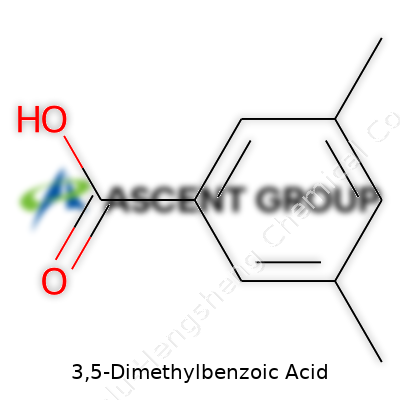
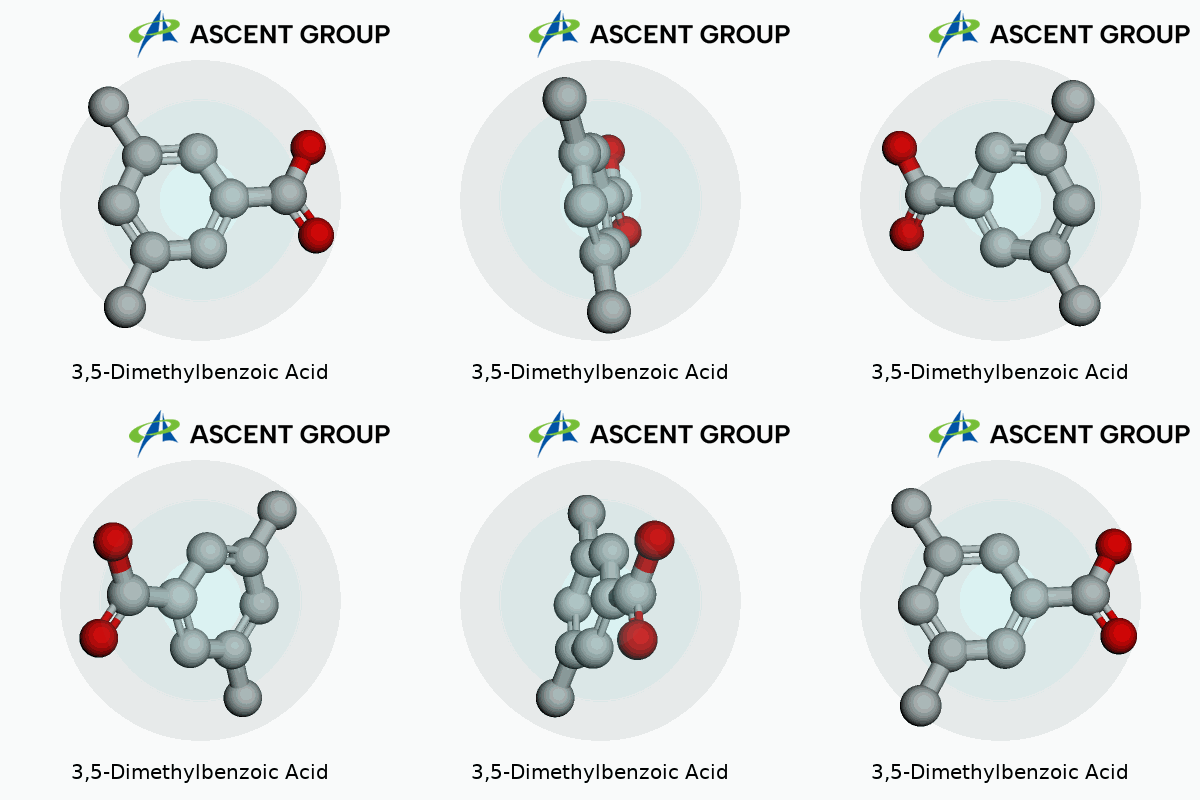
Years in chemical production teach you that knowing a compound’s structure gives you everything you need to predict its reactivity, purity concerns, and processing limits. 3,5-Dimethylbenzoic acid attracts interest because of the ways its two methyl groups influence its behavior compared to plain benzoic acid. Looking at the molecule, it builds on a benzene ring, but instead of just a single carboxylic acid group, you have two methyl groups attached at the 3 and 5 positions on the ring. The acid group remains at position 1. Count around the ring: the carboxylic acid anchors the numbering at position 1, then methyls branch off at 3 and 5.
The structure can be described in plain terms. Picture a benzene ring, add a COOH group at one position, then attach two CH3 groups, spaced apart on the ring. The proper formula comes out as C9H10O2. This boils down to its backbone—six carbons from benzene, two from the methyls, and all the substituent hydrogens find their slots. The formula describes the full atom count, but the arrangement drives its function in organic reactions and finished products.
We look at this molecule and immediately recognize the bulk of these methyl groups alters solubility and potentially lowers the melting point compared to the parent benzoic acid. Process technicians in our plant see these small tweaks making big impacts. During recrystallization, the position of methyl groups means different solvents or temperatures work better. Waste minimization often turns on seemingly small differences like this.
For years, benzoic acids served as core inputs in dye intermediates, flavor management, and certain pharma processes. 3,5-Dimethylbenzoic acid stands out for fine-tuning color chemistry and adjusting volatility. The methyl orientation often improves stability under the heat or in oxidizing conditions compared to closely related isomers. This can cut costs for stabilizers further down your process line. Plant data even show improved yields in many substitution reactions when using this arrangement, since steric hindrance differs compared to 2,4- or 2,6-dimethyl setups.
Getting this compound right means controlling contamination at the stage of methylation—residual isomers sneak in easily. Spectral analysis, especially NMR, reliably confirms correct methyl placement. Industrial-scale oxidations can drift, leading to side-chain isomers; in our own experience, best results come from tightly managed stepwise methylation on correctly substituted toluic acids, not the reverse. Customers ask us to share these production choices because they care about residuals that might influence their downstream chemistries.
Routine quality checks focus on melting point, infrared identification, and proton NMR for methyl group placement. Getting off-spec batches used to be more common, but stricter upstream control reduced offcuts dramatically in the last decade. Some processes may benefit from tailored purification, like fractional crystallization post-synthesis, to elevate product purity above the usual technical grade—especially for sensitive pharmaceutical or pigment lines.
Research teams increasingly look for green approaches, both for methylation and subsequent isolation. Tracking which solvents recover efficiently for reuse, as well as which acids yield the best separation profiles, forms the heart of process upgrades. Toluene oxidation still underpins the majority of global production, with process innovation driving safer conditions and lower environmental impact. Compact, modular reactor setups make it easier to scale runs up or down without losing control, which supports research batches as well as bulk needs.
Feedback from end users continues to shape the way manufacturers address purity and cost pressures. Real-world dialogue—chemist to chemist—often leads to custom runs or process tweaks. We see how collaboration across the industry keeps sharpening the edge on consistent, high-purity 3,5-dimethylbenzoic acid, opening new uses in organic synthesis every year.
In our industry, nothing sharpens your focus quicker than managing raw chemicals day in, day out. 3,5-Dimethylbenzoic acid runs through our facility in significant quantities—each pound handled with respect, not routine. Our own team members have seen firsthand the kind of complications that crop up during decanting or packaging, even though the chemical circles widely in research and production labs.
Handling 3,5-dimethylbenzoic acid starts with the basics: personal protective equipment. Splash goggles, chemical-resistant gloves, and lab coats aren’t optional. Even minor lapses, like bare skin or improvised eyewear, can mean skin irritation or worse. I’ve witnessed how a carelessly placed scoop or glove can transfer powder to equipment, then onto unintended surfaces—all because basic gear wasn’t used or checked.
Dust control makes a real difference in plant safety. The acid’s crystalline powder can get airborne during emptying sacks or transferring to bins. Our approach pulls from years of trial and error—using fume hoods, point-extraction systems, and dust-tight containers, instead of simply hoping for the best. A little inattention has led to employee discomfort or minor respiratory complaints, all avoidable with a solid dust-management plan.
Safe storage isn’t just about following rules. Moisture shortens shelf life, clumped product builds up inside valves, and accidental mixing with incompatible materials can mean headaches for the whole shift. Our climate-controlled warehouse keeps acids and oxidizers apart, and floors get checked daily for leaks or stray granules. Keeping containers sealed stops contamination and cross-contact, which keeps our QC rejects down. It’s rare now to see spoilage or mysterious clumps thanks to strict rotation and inspection.
Back in 2019, an unplanned spill taught us plenty. Fine, white powder coated a workstation, and it took a full-court press to confine the mess. Immediate response and dedicated spill kits proved their worth. Shovels, not brooms, pick up the bulk to avoid stirring up dust. Surfaces and floors get wiped with damp cloths and not rinsed straight to the drain. Staff training and regular drills keep response fresh—nobody has to pause to remember protocol. Quick communication with affected teams shuts down risk and keeps operations smooth.
By now, our disposal process for solid and liquid waste is tuned in. We segregate benzoic acid residues from regular trash, collect them into labeled containers, and work with licensed disposal providers. Years ago, a poorly labeled batch nearly left the facility with general waste. Transparent oversight fixed that, and regular audits now catch edge cases so nothing slips through. Flushing down the drain never enters the discussion, both from a regulatory and environmental standpoint.
Nobody in our field gets a free pass on safety. We watch out for each other. New hires stick close to experienced staff, and we all build on what went wrong last week or last year. Ingredient safety data guides us, but small adaptations matter most—whether that means swapping suppliers for better-packaged drums or redesigning scoopers to minimize airborne dust. A culture shaped by real experiences, not just checklists, keeps risk in check and production on track.
Long hours in chemical manufacturing teach plenty of things, but little matters more than safe storage. With 3,5-dimethylbenzoic acid, details like temperature, humidity, and even packaging shape the quality delivered to the customer. This isn’t theoretical for us. Batches exposed to the wrong conditions lose purity, pack poorly, or even create downstream headaches for those relying on tight specifications.
3,5-Dimethylbenzoic acid will draw in atmospheric moisture if left exposed, especially through poorly sealed containers. Even factory staff new to the industry spot powder that’s started forming clumps. That caking might seem trivial in storage, but for process lines using automated feeders or dissolvers, slumping powder can disrupt flow, add extra downtime, and eat into yields. To prevent moisture ingress, we only store this acid in tightly sealed, screw-cap polyethylene containers that never sit open between use. Desiccant packs help, especially during humid periods or for long-term holding.
Open storage areas or racking subject to direct sunlight have proven disastrous for us in the past. Chemical reactivity doesn’t just happen on a lab bench; storage temperature swings push impurities and throw off the appearance of 3,5-dimethylbenzoic acid. Our storage protocols specify temperatures between 15°C and 25°C. Warehouse thermostats and data loggers give the oversight needed to keep those numbers honest. We avoid warehouses that bake in summer or freeze in winter, no matter how convenient they might be.
We manufacture 3,5-dimethylbenzoic acid on multipurpose lines, so the risk of cross-contamination runs high unless every process step gets treated with respect. Even storage areas can present risks if they handle other aromatic acids, paraffinic powders, or strong-smelling solvents. Shared scoops or equipment, open buckets, and unlabelled residues—each has cost us time, money, and customer trust in the past. This chemical holds up best in dedicated, labeled containers kept apart from reactive or odorous goods. Physical barriers or separate rooms in the warehouse have proven worth every meter of floor space they consume.
We have learned that it’s not worth saving a few cents by cutting corners on containers. Polyethylene works because it doesn’t interact with the acid or add extraneous smells. Metal drums grew corrosion spots and leached particles in long-term tests, so we stopped using them. Small container sizes suit research orders, while large drums fit bulk customers—either way, damage to the sealing ring or threads invites trouble. Regular inspections catch cracks and keep storage conditions tight.
Mix-ups happen more easily than anyone likes to admit, especially as stocks move fast. We rely on clear, printed batch labels and inventory rotation. FIFO (first-in, first-out) helps keep the stock moving and slashes the risk of holding past-due product. This isn’t bureaucracy—it’s a check against degradation or loss in the warehouse, and in busy months, it saves staff from hunting down old containers or evaluating questionable product.
Every lesson written here comes from cleaning up after corners were cut or seeing finished product drop below spec. 3,5-Dimethylbenzoic acid may not seem sensitive day-to-day, but poor storage quickly undermines manufacturing gains. Keeping the temperature right, the containers sealed, and the warehouse organized—all rank with process control and raw material purity. Safe storage isn’t just about stability; it’s about keeping trust through every step until the final drum leaves the door.
3,5-Dimethylbenzoic acid is a specialty intermediate that finds its way into several advanced manufacturing processes, from fine chemicals to certain polymers. As a manufacturer involved since the days when demand for this compound stayed mostly in the lab, I’ve seen how expectations have changed with time. Years ago, a customer would call asking for a drum or a few hundred grams, curious about the melting point or moisture content. Now we get a range of questions, but two always show up: “Where can I buy 3,5-dimethylbenzoic acid?” and “What purity do you offer?” Buyers want to hear the answers from the people who make it, not a page on a distributor’s site.
Direct communication with us brings benefits often overlooked. We handle every single stage of production in-house, right down to packing the finished material. Our raw material sources and routine process checks allow us to guarantee every shipment’s batch consistency. Unlike what some might expect, manufacturers do answer technical questions, and that helps buyers troubleshoot downstream issues they would never suspect originated upstream. The impurities present in off-the-shelf material, often sourced through intermediaries, have reduced yields or complicated downstream purification for more than one end-user.
Sometimes, a buyer calls because a previous supply failed to dissolve as needed or throws reactions off completely. Tracing back, it usually comes down to off-spec purity or an unfamiliar impurity profile picked up from an extra reprocessing step or cross-contamination. Purity standards genuinely matter for high-performance products and research; our technical team works closely with customers to match specifications that actually fit real usage, not just what’s printed on a data sheet.
The average request we get is for 98% or higher. For certain applications, people specify 99% minimum, sometimes chasing even tighter ranges on specific contaminants—such as limiting isomeric byproducts or ensuring residual solvents fall below trace thresholds. Every batch here is checked before it leaves the plant. We publish HPLC and NMR data on request, and if somebody wants GC or mass spec analysis to check for a specific trace, we talk directly about feasibility and timelines. More customers have begun to demand COAs from the actual manufacturing site, not a re-packed warehouse.
End users working in pharmaceuticals and electronics call for the strictest standards. In those cases, we run extra purification and extended analysis per shipment, not just per lot. This can slow delivery, but compromises here cost everyone more in the end. Some companies aim for near-perfect number values but don’t provide batch-to-batch transparency. We keep archives and supply actual batch records. Real control gives repeatable quality, which should matter far more than numbers typed on a datasheet.
Trust grows the more clearly we communicate. We emphasize traceability—not just for regulators, but for our own peace of mind and our customers’ needs. Our doors are open to audits and samples are available before full-scale orders. Too often, buyers end up with material packaged by an unknown hand, processed on reused lines, or kept in subpar storage. As manufacturers, we stand by what we send out, and we expect questions: Ask for purity certificates. Request impurity profiles. Check our batch records if your production calls for extra reassurance. Open conversations up front lead to the best outcomes for everyone.