Industry’s journey with 3-Bromopyridine-2,6-dicarbonitrile began as synthetic organic chemistry moved toward more substituted heterocyclic building blocks for the pharmaceutical sector. During the late 20th century, as drug discovery labs demanded new scaffolds for design, pyridine derivatives got real attention. Our team responded to this demand by investing in modern halogenation and nitrile introduction methods, initially relying on much more dangerous reagents under limited reaction control. We saw real headway with improvements in selective bromination, especially as microchannel reactors improved consistency and yield. Years of iterative adaptation—from batch flask to continuous flow—let us push past the moderate yields early researchers encountered, reducing both waste and batch variability. This allowed us to deliver a standard of quality that synthetic chemists in R&D settings could depend on. The history is not just about technological milestones but lessons in scaling up from bench to tonnage without losing sight of purity or reproducibility.
3-Bromopyridine-2,6-dicarbonitrile stands out among bromopyridines because it holds two strategically placed nitrile groups, both electron-withdrawing, which give the pyridine ring a unique reactivity profile. We’ve supplied this compound mainly to pharmaceutical discovery groups, agrochemical innovators, and advanced materials researchers who value predictable reactivity. Its rigid structure and compatibility with a broad slice of organometallic transformations make it a strong candidate for scaffold elaboration. Over repeated campaigns, we’ve optimized production not just for volume but for chemistry grade: targeting minimal impurity levels and high isomeric purity that grant confidence in downstream applications. In this way, we don’t see this molecule as a mere commodity, but as a versatile stepping-stone for truly novel chemistry.
3-Bromopyridine-2,6-dicarbonitrile comes as a crystalline solid with a pale yellow to off-white color formed by its conjugated system. The expected melting range falls between 140°C and 145°C, driven by stabilizing intermolecular forces. The molecule’s solubility profile shows strong affinity for polar aprotic solvents like DMF and DMSO, making it friendly for high-throughput synthesis setups. Volatility remains low, a welcome factor for safe handling in bulk. The presence of two cyano groups pulls electron density away from the ring, stabilizing it under a variety of oxidation conditions. The bromine substituent gives the ring a handle for cross-coupling, unlocking access to complex heteroaromatic arrays.
Out of necessity, we tag every drum and bottle with data from triple-batch GC and HPLC analysis, focusing on active content—typically over 98 percent—and strict matching to spectral signatures (NMR, IR, MS). Our team locks in moisture and volatile impurity content via Karl Fischer and GC methods, as water can undermine certain coupling operations. Packing is tamper-evident, nitrogen-flushed, and adapted to shipping routes. Labels reflect precise batch information and hazard warnings in accordance with GHS. Every set of documentation supports traceability to raw materials and lot-specific test results, protecting both our clients and our reputation for reliability.
Production starts with 2,6-dichloropyridine as the base stock. Our main route applies a direct Sandmeyer-type bromination using copper(I) bromide under carefully regulated temperature and pressure, balancing speed and selectivity to minimize side products like dibrominated or unreacted precursors. After introducing the bromine, we run a cyanation step, where copper(I) cyanide inserts nitrile groups with close control. Filtration, multi-stage crystallization, and vacuum drying extract the pure product. Years of process development zeroed in on the greenest solvents and lowest energy regimes that maintain both safety and yield, cutting down hazardous byproduct formation.
Chemists rely on the bromine’s position for Suzuki, Heck, and Stille cross-couplings, which install everything from biaryl cores to advanced heterocycles. The two cyano groups can transform into amides through hydration under acid catalysis or reduced with selective hydride sources to introduce primary amines. In exploratory projects, some teams convert 3-Bromopyridine-2,6-dicarbonitrile into fused ring systems using base-promoted annulations, widening its range well beyond standard arylations. Experience shows that keeping bromide impurities below detection threshold prevents false positives in downstream coupling screens, reinforcing the need for clean production.
Depending on geography and supplier tradition, this compound appears as 3-bromo-2,6-pyridinedicarbonitrile, 3-bromo-2,6-dicyanopyridine, or just BPDN among process chemists in the know. CAS designation helps avoid mix-ups, as similar compounds crowd the marketplace. Early years proved the importance of clear bulk labeling and harmonization with IUPAC names to ensure receipt of the intended material, especially for regulatory submissions and material transfer in global projects.
We enforce detailed handling SOPs across our plants, mandating chemical-resistant gloves, splash goggles, and strict containment on open dispensing. The product’s dust can irritate airways, with moderate risk of cutaneous or ocular exposure in the absence of running exhaust ventilation. Exposure limits track closely with other halogenated pyridines, so we built in vapor detectors and high-throughput bag-out stations. Waste streams run through multi-stage neutralization, targeting brominated and nitrile effluent separately—minimizing environmental and workplace risk. Training programs for all operators reinforce both compliance and good judgment in hazard scenarios. Every lot we ship comes with comprehensive SDS documentation built into the QA release cycle.
Pharma clients center on this molecule for advanced library synthesis and fragment-based design, using its reactivity to test new kinase inhibitors and anti-infective candidates. Agrochemical groups turn to it for heterocyclic scaffolds underlying modern crop protection products, where metabolic stability and target selectivity matter. Electronics teams began exploring modified derivatives in the hunt for organic semiconductors and advanced dyes. Each industry drills into different aspects: whether it’s late-stage functionalization, tight impurity control, or cost-effective scale-up, real-world adoption comes down to a track record of performance on the bench and in pilot campaigns.
R&D never stands still. We invest resources in high-throughput screening platforms, pushing coupling yields and catalyst efficiency with every campaign. Analytical chemists develop new metrics for identifying trace-level process byproducts, using UHPLC and HRMS technology to drive batch release standards. Internal teams prototype new crystallization protocols aiming for energy savings and solvent reduction. To meet evolving regulatory standards and global customer projects, our collaboration network links academic labs and CRO partners around the world, broadening access to new synthetic pathways and safety data. Each process improvement, no matter how granular, becomes part of a rolling database that shapes both cost-of-goods and end-user experience.
Regular review of toxicological literature complements our in-house testing. 3-Bromopyridine-2,6-dicarbonitrile demonstrates moderate acute oral and dermal toxicity in established animal models, aligning with trends seen in similar pyridine derivatives. No strong genotoxicity or carcinogenicity signals have emerged when tested against industry-standard protocols, though metabolic studies advise caution in directly scaling to human exposure. We coordinate annual independent audits of hazard assessment protocols and maintain a high degree of transparency in material hazard labeling, conforming to both US and international norms.
The landscape for 3-Bromopyridine-2,6-dicarbonitrile continues shifting as industries chase specialty chemical building blocks. With AI-driven drug and material discovery on the rise, demand for structurally unique pyridines stays robust. Our next development cycles focus on greener halogenation and continuous cyanation, aiming to sharpen both cost structure and sustainability. Tighter regulatory limits on wastewater and workplace exposure add incentive to innovate at every plant node. As we anticipate stricter scrutiny and new synthetic applications, our commitment to open data sharing and cross-sector partnerships will shape the molecule’s next chapter—from specialty pharma to specialty polymers.
Anyone who tracks fine chemicals in applied research or manufacturing will have run into specialty pyridine derivatives. 3-Bromopyridine-2,6-dicarbonitrile, as straightforward as the name sounds, builds a bridge between halogenated aromatic heterocycles and nitrile functionality. Molecular structure has a way of predicting behavior at the bench and at scale, so learning it isn’t an academic exercise—it’s about reliable process planning and predictable synthesis outcomes.
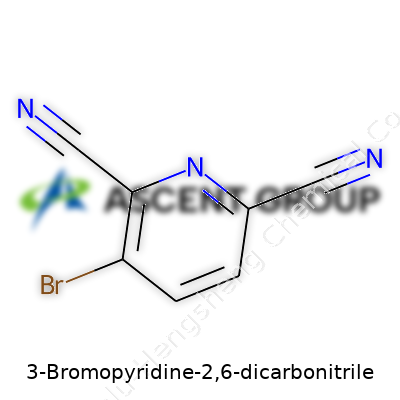
Start with the basic pyridine ring, then picture a bromine sitting on the third carbon, with nitrile groups attached to carbons two and six. Ask anyone in a plant setting, and they’ll say knowing placement of each atom cuts troubleshooting time during scale-up. Every functional group matters—electronic effects and reactivity can surprise even seasoned chemists during coupling, halogen exchanges, or functional group protection steps. The full molecular formula tells you how the elements add up. For 3-Bromopyridine-2,6-dicarbonitrile, it looks like this: C7H2BrN3.
Speaking from years overseeing custom synthesis projects, smaller changes in position or substituents on pyridines drive differences in yield, byproducts, or handling characteristics. On paper, swapping a nitrile for a carboxylate just means changing a letter, but in the plant, that might shift a reaction profile or impact solubility in your workup.
Many research teams hunt for intermediates to speed up lead optimization or build blocks for pharmaceuticals and electronics. Here, brominated pyridines offer coupling handles for Suzuki or Buchwald research, while the dicarbonitrile stretch acts as a point for further elaboration. Faced with downstream demands, knowing every atom’s position in C7H2BrN3 helps process engineers avoid unnecessary steps and select the right solvents or reagents. Any miscalculation increases raw material usage, energy consumption, or, worse, triggers challenging purifications.
Over time, the popularity of niche chemicals like this pyridine derivative rises and falls. Mainstream catalogs rarely stock specialty pyridines in large lots, so many researchers rely on direct manufacturers. People on our production line keep hearing, “Who really makes it? Where does it come from?” That push for transparency reflects actual experience—off-spec product can reroute entire syntheses, wasting resources and effecting timetables.
Quality control teams demand details: purity, residual solvents, precise analytical data. Even slight impurities in precursors like 3-Bromopyridine-2,6-dicarbonitrile can compromise hydrogenation or cross-coupling outcomes. Consistency starts at the supplier’s reactor, supported by analytical verification: NMR, LC-MS, and sometimes even elemental analysis—all grounded in a clear understanding of the molecular structure.
Long experience has taught that sharing real molecular details, particularly precise formulas, reduces risk for downstream partners. For the chemistry community, supply chain resilience starts with reliable sourcing and unambiguous molecular information. Anyone scaling up a new process appreciates clear communication, not just claims of ‘purity’ or ‘fit for purpose.’
A single number out of place in the molecular formula—C7H2BrN3, in this case—can cost days or weeks fixing preventable errors. Not every operation needs the background textbook knowledge, but everyone appreciates when the supplier knows their own products. Customers and colleagues gain confidence when details, starting with the correct formula, match up at every level—lab, kilo plant, and beyond.
Every shift inside our facility says something about what it takes to turn a niche compound like 3-Bromopyridine-2,6-dicarbonitrile into value. The story doesn’t start in the boardroom or in some glossy sales catalog. It starts with experienced hands, steel reaction vessels, careful temperature control — and clear reasons for making this molecule in the first place.
The biggest demand for 3-Bromopyridine-2,6-dicarbonitrile comes from pharmaceutical innovators. Medicinal chemists trust its skeleton to build advanced heterocyclic compounds. The two cyano groups on the pyridine ring create a powerful foundation for synthetic steps used in drug discovery. Adding that bromine atom at the 3-position invites further chemistry. It gives chemists a handle for Suzuki and Buchwald–Hartwig cross-coupling — allowing for quick modification and optimization of lead compounds.
Teams deep in API research specify our compound when searching for kinase inhibitors or anti-proliferative agents. Its structure can mimic key biological motifs, especially when combined with aromatic or amide moieties. Often, we see requests from project managers involved in oncology or neurological disorder pipeline candidates. These aren’t abstract trends: they show up in monthly production requests and batch records.
Agricultural research labs also knock on our door for this intermediate. Synthetic routes to novel crop protection agents often pass through pyridine-dicarbonitrile chemistry. The same electron-withdrawing cyano groups encourage peripheral modification on the pyridine ring — helping biologists tune activity against insect pests or invasive weeds. This translates to a practical advantage for designers of new herbicides or insecticides. Hard data from recent projects show that modulation at the bromine position leads to measurable differences in field trial results.
Outside pharma and agro, cutting-edge materials research sometimes involves our compound. Specialty polymers and advanced electronic materials call for tailored building blocks. Pyridine derivatives can impart specific electronic properties, and those cyano and bromo functions steer polymer structure and conductivity. Though this doesn’t drive high-volume output, it keeps us flexible in production scheduling and synthesis know-how.
Every gram produced takes care and know-how. The reactivity of the cyano and bromo groups means safety and environmental controls matter. Waste streams must be treated thoroughly, and we have invested in state-of-the-art scrubber systems to limit emissions. Pricing reflects the labor and equipment maintenance needed; customers benefit when we collaborate early on technical feedback, purification, and logistics.
The main issue isn’t how to make the molecule — experience and reliable sourcing lock in high purity and reproducibility batch after batch. The bigger discussion focuses on supply chain unpredictability. Raw material fluctuations impact scheduling. Co-developing long-term demand forecasts with customers avoids bottlenecks. Open feedback on downstream synthetic routes sometimes uncovers easier purification methods or alternative grades that cut unnecessary steps for the end user.
Those who use 3-Bromopyridine-2,6-dicarbonitrile need a partner that brings both technical credibility and honest support. Projects run best when both sides share knowledge openly — from impurity profiles in the mother liquor to tweaks in solvent volumes at scale-up. Real results, not marketing promises, shape the backbone of our operation. Confidence from returning customers signals where we hit the mark and where there’s still room to earn trust.
Every manufacturer working with 3-Bromopyridine-2,6-dicarbonitrile knows that this isn’t an ordinary intermediate. Inside the plant, we treat it with a mix of respect and practical caution. The molecule itself brings complexity—its brominated structure and the presence of nitrile groups call for vigilance, both on the bench and in storage.
On a typical shift, nobody overlooks the need for high-standard ventilation. Fume hoods, local exhaust systems, and fully enclosed processes minimize workers’ exposure. The compound does more than smell sharp; dusts or vapors can stress the eyes and respiratory tract quickly if good airflow is missing. Full-face respirators make occasional appearances, especially during weighing or transfer.
Gloves aren’t optional. We use nitrile or neoprene gloves since common latex degrades too quickly. More than a few new operators get surprised—skin contact stings, so double-gloving on big batch days isn’t overkill. Splashes happen during charging or drum change-outs. Eye wash stations get tested as part of routine safety checks, not after the fact.
Dry, well-ventilated storage takes down most accident risks. We never stack this material with oxidizers or acids—chemically incompatible substances create too many unpredictable scenarios. Labeling tightens accountability. Every drum and contained vessel comes with a clear tag specifying hazards, right down to the UN number that our logistics staff memorize over time.
We don’t just store; we keep an eye on humidity. Moisture exposure clumps the powder, complicating dosing and making cleanup harder. Dehumidifiers become silent heroes in the warehouse, especially during rainy seasons. Flammable storage cabinets with integrated spill containment further insulate the inventory from unpredictable leaks.
Most safety problems start with shortcuts. Our new staff learn through hands-on mentorship, not manuals alone. They see actual containers, try out real transfers, and go through simulated spill drills. Immediate, on-the-floor feedback helps absorb lessons that stick.
Through experience, we know cleanup readiness saves time. Absorbent pads and spill kits sit close to every work zone. Fast isolation stops small messes from growing into bigger hazards. Waste handling means sealing contaminated pads and gloves without hesitation, then using approved disposal methods. Routine audits keep these habits sharp.
Compliance anchors all our steps. Governments routinely check labeling, containment systems, and transport records. GHS-compliant labels aren’t just legal boxes to tick—they alert everyone, especially third-party haulers, to what they’re moving.
Process tweaks happen after every near-miss or incident investigation. Fully automated dosing systems have been the biggest safety game-changer. Operators observe, machines add exact amounts, and exposure falls even further. We invest in preventive maintenance, catching leaks and corrosion early.
Long-term, it’s clear that chemical knowledge paired with discipline underpins every safe batch we make. Tighter controls, constant vigilance, and practical knowledge—this is what keeps both our team and our product secure, batch after batch.
For years in chemical manufacturing, integrating substances with absolute accuracy underpins the entire workflow. The CAS number, serving as a unique identifier, cuts down ambiguities—especially for structurally complex molecules like 3-Bromopyridine-2,6-dicarbonitrile. The CAS number for this compound is 5113-89-3, a critical piece of information for regulatory filings, safety data sheets, and procurement logistics.
Manufacturing runs don’t have room for error when raw materials enter the plant. Swapping a similar pyridine derivative due to a CAS number slip-up not only costs valuable production time but may also result in product recalls or wasted batches. For those of us managing thousands of chemical entries, skimming over CAS details carries risk: customers relying on our output expect consistent, reliable performance every time. 3-Bromopyridine-2,6-dicarbonitrile serves as a key building block in specialized chemical synthesis, so accuracy here matters more than in almost any other step.
Chemicals destined for export or pharmaceutical production involve cross-border compliance. Agencies often cross-check our submissions using the CAS number; mislabeling has led to detention of shipments, extra fees, and strained client relationships. Familiarity with the correct number streamlines regulatory paperwork and builds trust among auditors. Colleagues in our compliance department keep close tabs on these details, and registration demands this unique identifier. Without it, the best safety documentation or analytical certificate falls short.
Accurate identification increases traceability throughout the supply chain. A producer’s reputation rests on the ability to provide full documentation, not only for end-users, but also for internal logistics, warehouse teams, and transport partners. It is not uncommon for a client to require sourcing data several years after original delivery. With the right CAS number, retrieval occurs quickly, helping us demonstrate accountability during audits or incident investigations. 3-Bromopyridine-2,6-dicarbonitrile carries niche applications, which means our clients are often chemists themselves, and they notice every detail we print. A clear CAS number on our paperwork enables clean integration into R&D protocols and manufacturing batches.
Digitizing inventory comes with new demands too. Most inventory management and procurement platforms key records by CAS number, not by long chemical names, some of which include dashes, numerals, and prefixes that lead to typographical errors. For anyone running an order entry system or catalog search, accuracy at this fundamental level means fewer downstream issues. In recent years we invested in automated verification tools to double check every CAS entry before a customer receives a quote or purchase order. Cases where companies skipped this step saw double-handling at best, loss of reputation at worst.
Every production chemist, sales manager, and documentation specialist ought to understand the implications of using the correct CAS number—5113-89-3 for 3-Bromopyridine-2,6-dicarbonitrile. Training staff, maintaining up-to-date chemical libraries, and keeping open channels between sales and compliance teams all help lower risk. The extra five seconds it takes to validate CAS details pays off with fewer shipping glitches and more reliable end products. New team members quickly learn the difference that diligent cataloging can make. In the crowded chemical manufacturing marketplace, nothing demonstrates technical know-how quite like correct, consistent data.
There’s a simple truth in chemical manufacturing: reliable purity is only possible through close attention to process detail, not only in the lab but right on the production floor. In the case of 3-Bromopyridine-2,6-dicarbonitrile, purity becomes more than a marketing sticker. We see requests for this building block from pharmaceutical companies, contract synthesis labs, and agrochemical developers. Their specifications usually land at 98 percent or higher—anything below 98 percent limits its utility for most pharmaceutical intermediates and specialty chemicals. This compound comes with its own quirks, which make holding high purity a technical challenge, not a given.
High-purity materials underpin successful R&D and scale-up work. Impurities in heterocyclic nitriles like this one aren’t just theoretical; even small amounts of brominated side-products, residual solvents, or unreacted starting materials can derail downstream reactions. Unwanted peaks in a chromatogram mean extra purification steps, lower yields, and in regulated sectors, greater scrutiny from auditors. Years ago, we tried cutting corners with column chromatography on a rush project, only for the subtle brominated byproducts to show up in the final analysis. A client flagged the batch at 96 percent. For their synthesis route, this risked not only a delay but regulatory fallout later downstream.
Most commercially available batches of 3-Bromopyridine-2,6-dicarbonitrile clock in at 98 to 99 percent. Some academic sources may mention 97 percent, but our customers rarely go for it, unless it’s pilot scale testing or non-critical research. Achieving a consistent 99 percent purity means investing in good process equipment, reliable analytical capabilities (most often HPLC, NMR, or GC-MS), and training operators to recognize subtle off-spec signals. Purity drifts higher when raw materials are fresh, solvents are dry, and air/moisture are kept away from open reactions. It rarely pays to pressurize output if any of these aren’t under control: the process will generate more unwanted isomers and more off-color batches, which usually means rework or disposal.
Every now and then, the industry receives queries for even higher purity grades—upward of 99.5 percent—usually when the end-use sits right upstream from an API or another critical intermediate. These runs add cost and time, since they require extra purification such as recrystallization under inert conditions or preparative chromatography. The market could use more clarity. Some “technical grade” offers can be as low as 95 percent, but those rarely see pharmaceutical or advanced materials applications. Without adequate transparency, an end-user might order based on price alone and miss downstream failure signals until much later in their process. If the industry settles toward a well-communicated minimum standard—98 percent, backed by a clear COA—not just quality but trust benefits everyone from manufacturer to end customer.
Watching the data come off the HPLC or seeing a colorless crystalline product pack into drums gives a sense of certainty; it means the process worked, controls held, and customers get what they rely on. For us, purity doesn’t come from a sticker or claim. It’s the direct outcome of design decisions, disciplined chemistry, and feedback from people who actually use the material under pressure. If a spec matters, there’s often a story behind it—one that includes a headache or near-miss that only rigorous manufacturing can solve. The process will always yield unexpected impurities, but experience, the right tools, and listening to chemists at every step keep the difference between a passable product and a trusted one.