For more than a century, adipic acid has played a pivotal role in the world of industrial chemistry. Its commercial path began in earnest during the 1940s, as nylon production surged. The early patents outlined methods for oxidizing various hydrocarbons, but the breakthrough hit with the oxidation of cyclohexanol and cyclohexanone—a process that steadily replaced coal tar as the main source. In my decades walking through production facilities, I’ve seen how chemical engineering around adipic acid helped take synthetic fibers from experimental batches to full-scale mills. Chemists and process engineers worked side by side, not only scaling up but finding ways to use air and readily available catalysts so the industry could meet post-war demand for tough, flexible polymers. Supply lines changed, processes matured, and production facilities expanded in America, Europe, and Asia, shaping much of the world’s modern plastics and coatings markets.
Adipic acid shows up as a pure white, free-flowing granule or powder. From a manufacturer's perspective, the focus remains on achieving exceptional purity—impurities don’t just impact downstream polymerization yields but also dictate whether our product ends up in high-performance automotive parts or in less demanding end-uses. Demand from nylon 6,6 and polyurethane manufacturers has kept output ticking upwards for decades. As a core intermediate, adipic acid stands out in our portfolio because it ties together multiple sectors, from textiles to food additives. Its versatility makes it a linchpin within the supply chains of everything from sportswear to automotive belts.
Technical teams in our plants stay focused on several defining properties. Adipic acid melts around 152 degrees Celsius, dissolves well in hot water, and exhibits stability in storage so long as warehouses stay dry and cool. Its solid structure, lack of significant odor, and low volatility allow handling in bulk without elaborate containment, but dust control remains a daily reality. Where end-use requires crystal clarity or low coloration, our process lines keep tight controls on iron and other trace metals. Chemically, the molecule carries two carboxyl groups separated by a flexible hexamethylene chain; this not only lends itself to polymerization but also catalyzes innovation for new materials in both plastics and coatings.
We differentiate adipic acid lots by assessing melting point, color values, iron content, and water content. Quality teams scrutinize every metric before shipping. We comply with ISO standards as well as regionally relevant chemical safety legislation—whether it’s REACH compliance in Europe or TSCA in the United States. Labels on every silo, drum, or bulk tanker reflect not just the name and hazard class, but real manufacturing parameters, batch numbers, and purity verified in the plant’s analysis lab. Years back, one tighter specification from a major client set in motion a full process renovation to meet a stricter water content limit, proving how market needs push us to improve.
Traditional production starts with cyclohexane oxidation, which generates a mix of cyclohexanol and cyclohexanone. Air (or, less commonly, nitric acid) serves as an oxidant in giant reactors. The challenge centers around maximizing yield while limiting byproduct formation—a balance of temperature, pressure, and residence time. Our operators rely on continuous improvements, automating sensors and feedback loops to track every variable. Efficient energy use keeps costs down and reduces the carbon footprint, an area where everyone in the sector faces increasing scrutiny. Waste nitrous oxide once left as a troublesome greenhouse gas is now collected and catalytically decomposed or captured, an example of how environmental responsibility takes technological commitment.
Inside our labs, the carboxyl groups of adipic acid serve as prime reaction sites. Most of the global supply reacts with hexamethylenediamine to form nylon 6,6—chains built by step-growth polymerization, yielding fibers as strong as steel for their weight. In polyurethane manufacture, we see adipic acid converted via polyester polyols as intermediates, supporting a breadth of foams and elastomers. Newer lines of research play with partial hydrogenation or functional group extension, aiming to create higher-value derivatives for surfactants, plasticizers, and lubricant additives. Field trials with alternative diamines and modified acid structures continue to spark possibilities, pressed by customers searching for sustainability or new performance benchmarks.
Practically every invoice, customs form, and purchasing contract references adipic acid, but over the decades, we’ve worked with synonyms like hexanedioic acid, 1,6-hexanedioic acid, and, less often, codes such as “AA.” End-users in food technology may know it by E355, referring to its application as an acidity regulator. Understanding the ways regulatory agencies or downstream clients refer to our product matters for logistics and compliance checks, cutting down on miscommunication wherever we load a shipment.
Factory teams handle adipic acid consciously. The solid dust can irritate eyes, skin, and respiratory tracts, so personal protective equipment is non-negotiable. Conveyor enclosures and local exhaust ventilation aren’t simply best practices—they’re essential for health. Spill protocols focus on containment and minimizing waterway exposure. Our staff receive regular hazard training and drills, and we document all incident responses for regulatory audits. Long-term safety doesn’t happen overnight; continuous investment in detection systems and operational reviews reduces downtime and builds employee confidence. Each improvement, big or small, gets measured in incident statistics we track every year.
The largest share of our output goes into nylon 6,6, forming resilient fibers for tire cords and industrial yarns, but the reach goes beyond that. Polyurethanes, resins, plasticizers, and lubricants draw from our adipic acid lines to achieve the right balance of flexibility and durability. Food industry batches find a place in sweeteners and acidulants, with volumes tightly managed and traceability high. Pharmaceuticals, adhesives, and even synthetic leather round out the landscape. The breadth of application makes demand forecasting both complex and rewarding, since what happens in one end market—say, a new fuel economy regulation impacting automotive—ripples back to raw material requirements and plant scheduling within days.
Consulting with our R&D chemists reveals an energetic focus on more sustainable processes. Efforts gear toward lowering emissions by finding bio-based feedstocks from renewable sources; pilot units trial fermentation pathways using glucose or other carbohydrates instead of petrochemicals. Scientists in-house and at partner institutions continue mapping catalysis and process intensification, aiming to push energy efficiency further. Customers challenge us to boost purity for advanced polymers or engineer novel derivatives for niche uses. Collaboration across production, quality assurance, and sales drives new product rollouts. Recent years have brought small-scale trials producing cyclic and branched analogues, setting sights on higher-functionality monomers for the next generation of specialty polymers.
Toxicological assessments on adipic acid point to moderate irritation risk from dust and concentrated solutions, but acute and chronic toxicity both sit at low thresholds compared to many industrial chemicals. Our occupational health teams actively contribute to ongoing research, monitoring exposure through air sampling and biological indicators among staff. Decades of data support the confidence that, under well-controlled conditions and established operational procedures, serious health risks remain rare. Environmental fate is not taken lightly; wastewater streams undergo neutralization and biological treatment before discharge. Industry-wide databases and government reports continue to guide us, as new analytical tools make it possible to detect effects at lower concentrations.
Looking forward, changes in regulatory landscapes and customer preferences place a premium on greener chemistry. Bio-based adipic acid attracts huge R&D attention—scaling up these processes without cost penalties or purity drops presents a challenge worth solving. Energy integration and carbon capture add further engineering targets for both new and retrofitted plants. On the customer side, engineers in composites and electronics anticipate next-generation polymers with tailored mechanical or thermal properties, pushing us to keep innovating. The transition toward circularity—either by recycling polyamide waste or designing degradable alternatives—commands strong effort at every level of our operation. Workshops and conferences around the globe buzz with both optimism and real-world constraints as we build on a legacy of process reliability to create new chemistry for tomorrow’s industries.
In the world of industrial chemistry, few compounds have shaped modern manufacturing quite like adipic acid. As someone from the production side, not just someone reading from a datasheet, I see its application and impact with each batch leaving our reactors. The most visible product that starts in our plant: nylon 6,6, a reliable workhorse in automotive, electronics, and consumer goods. This connection rarely gets highlighted in media coverage, but manufacturers see the demand from automotive suppliers, carpet mills, and textile producers who rely on a steady stream of this intermediate. The need comes from nylon’s proven strength and resistance to wear—a direct outcome of carefully controlled chemical reactions starting from adipic acid.
While the spotlight tends to land on nylon, the reach of adipic acid doesn’t end there. Manufacturers who create polyurethane foams for mattresses, furniture, car seats, and insulation source adipic acid-based polyols. Polyurethane made using our product achieves a blend of flexibility and durability that furniture makers and automakers need for comfort and lasting value. Our technical teams get troubleshooting calls from partners in these industries who know the importance of the exact grade and purity in the foam’s performance.
It surprises many outside the chemical sector to learn that food industry formulators buy adipic acid for its tart flavor and buffering properties. The U.S. Food and Drug Administration recognizes certain grades as safe for use in beverages, gelatin desserts, and baking powders. Quality and traceability matter here: our food industry customers ask tough questions about trace metal impurities, bagging practices, and storage conditions. They need consistent results or risk recalls and product waste.
One area where we face complex challenges is in reducing environmental footprint. The manufacture of adipic acid, if not managed carefully, produces nitrous oxide—a greenhouse gas with significant warming potential. Our plant invested in emissions abatement reactors to pull more than 98% of this gas out of waste streams. This push came from regulatory trends and demands from responsible buyers. Teams on our shop floor monitor and control emissions through every shift, knowing these gas capture systems protect both air quality and the company’s right to operate.
Adipic acid is not just a commodity that flows through global supply chains. Each shipment represents jobs, safety checks, and decades of incremental improvements in process technology. Companies continue to invest in catalysts and feedstock innovation, targeting lower costs and higher sustainability. Some are piloting bio-based routes that cut dependence on fossil-derived benzene and cyclohexane, but these processes face real hurdles in scale and cost right now. From my viewpoint, progress depends on practical, scalable steps rather than overnight transformation. End-users want improved sustainability, but they cannot sacrifice quality or supply reliability. The shared future for the chemical industry and its customers depends on solutions that work in the field, backed by real results and a commitment to continuous learning.
In our daily work producing adipic acid, we watch millions of kilograms leave our facilities destined for manufacturing plants around the world. The largest share flows straight into the production of nylon 6,6, a polymer that has shaped industrial and consumer goods over the past century. Car makers depend on nylon 6,6 for under-the-hood parts, airbag fabrics, and seatbelt yarns. Textile producers use it for tough, resilient fibers. This isn’t just an interesting fact—for us, producing pure, consistent adipic acid literally keeps supply chains moving and cars on the road.
Adipic acid helps build some of the strongest plastics in mass production today. Its role as a key building block means attention to purity matters. Any variation in our batches leads to weaker polymer chains or off-spec nylon, which downstream processors reject. We keep close tabs on impurity profiles, residual moisture, and batch-to-batch consistency for this reason. Waste or poorly made lots never reach customers. This kind of reliability underpins why industrial buyers trust direct-from-manufacturer supply rather than brokers or resellers.
Nylon production takes the lion’s share, but adipic acid finds many other uses. Polyurethane manufacturers add our product to flexible and rigid foam recipes. Furniture, mattresses, and insulation panels made with these foams stay in shape longer because adipic acid improves cellular structure in the polymer network. We regularly tailor particle size for foam blenders, because they see a direct link between our lot consistency and their yields.
Food producers, especially beverage makers, turn to food-grade adipic acid as a specialty acidulant in powdered drinks. We refine and filter to high standards, because off-tastes and even trace contaminants show up in their final product. With tightening regulations, both domestic and export buyers scrutinize batch traceability and certificates. Pushing for even higher purity, we constantly update our separation and filtration systems; product recalls cost dearly, so prevention starts at our end.
We know well the scrutiny adipic acid attracts as a large-volume commodity. Manufacturing creates nitrous oxide, a potent greenhouse gas. Our teams devote real effort to process improvements. Catalysts and new reactor designs capture more nitrous oxide than before, cutting emissions at the source. Often, research and equipment upgrades demand significant investment, but both regulators and our customers increasingly ask for hard proof of reductions. Long-term contracts sometimes now stipulate landfill, water, and air emission reductions linked to our supply.
Every innovation we implement reflects both environmental needs and the growing expectations from our partners. We find that technical transparency and willingness to pilot new technologies become more valuable than simply touting product quality.
Adipic acid has a unique role at the crossroad of materials science, food technology, and sustainability challenges. Our daily production ties us not only to factories making fabrics and plastics, but also to ongoing debates about resource management and environmental impact. Customer trust grows out of not only meeting technical specs but from sharing in the work of safer manufacturing and steady progress toward cleaner processes.
Every day in our plant, we work in close proximity with adipic acid. Our team produces it by oxidizing cyclohexanone and cyclohexanol, and we see the entire process from raw material to finished white crystalline product. This gives us a grounded understanding of what safe handling really looks like—not just instructions from a datasheet, but the real habits and practices proven through hands-on experience.
Workers encounter adipic acid in bulk forms: big bags, open drums, or direct line transfers. Proper industrial hygiene and personal protective equipment keep us safe. The powder can cause mild irritation if it contacts the skin or eyes. Inhalation of dust can lead to coughing or short-term discomfort,—so local exhaust ventilation, safety goggles, gloves, and dust masks form the standard uniform. We stress prompt clean-up of any powder spills using careful handling instead of sweeping, as sweeping creates unnecessary airborne dust. Regular air quality checks make sure dust levels never approach occupational exposure limits set by regulatory agencies like OSHA or ACGIH. Over decades, adherence to these protocols keeps incidents vanishingly rare in our operation.
Manufacturers in the polymer, food, and coatings sectors rely on adipic acid for nylon production, acidulants, and specialty resins. The food grade version meets strict purity standards. Every batch we send out has passed rigorous analysis for contaminants and residual solvents. Downstream users sometimes worry about ingestion risks or combustion byproducts. Adipic acid itself does not exhibit acute toxicity when handled with basic care. Its combustion, though, can release carbon monoxide and other gases, so we stress keeping it away from flames or high heat during storage and processing. Storage in cool, dry, and well-ventilated places preserves quality and reduces risk.
The environmental side cannot be ignored. Large-scale releases threaten local water with increased acidity, and regulatory bodies have set discharge limits accordingly. We continuously monitor wastewater streams, neutralizing acidity as needed. All waste or off-spec batches are disposed of in approved facilities. We track changes in REACH and TSCA regulations to stay compliant, and we notify our partners of any developments that might affect handling requirements. In our region, best practices have evolved alongside community health studies that document the absence of chronic effects in long-term workers. Adipic acid’s record remains clean when handled properly.
Safety lives in experience-backed routines: careful choice of PPE, well-designed ventilation, smart housekeeping, regular training, and quick adoption of feedback from the shop floor. We integrate mechanisms for employee feedback and routinely check protocols against the latest industry data and accidents reported elsewhere. Good safety culture—one that rewards careful work and open communication—drives incident rates as low as possible. For newcomers, hands-on mentorship pairs with practical training, making sure no one learns the hard way.
Our experience is clear: adipic acid can be handled and used safely wherever vigilance, training, and respect for the material guide operations. Industries that treat safety as an ongoing discipline—not a box to check once—find that confidence grows with practice, and risks shrink with each cycle of worker-driven improvement. Real safety transcends paperwork; it lives in the habits, discipline, and shared know-how built up across years in manufacturing.
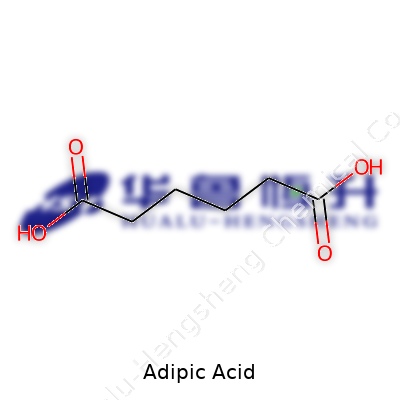
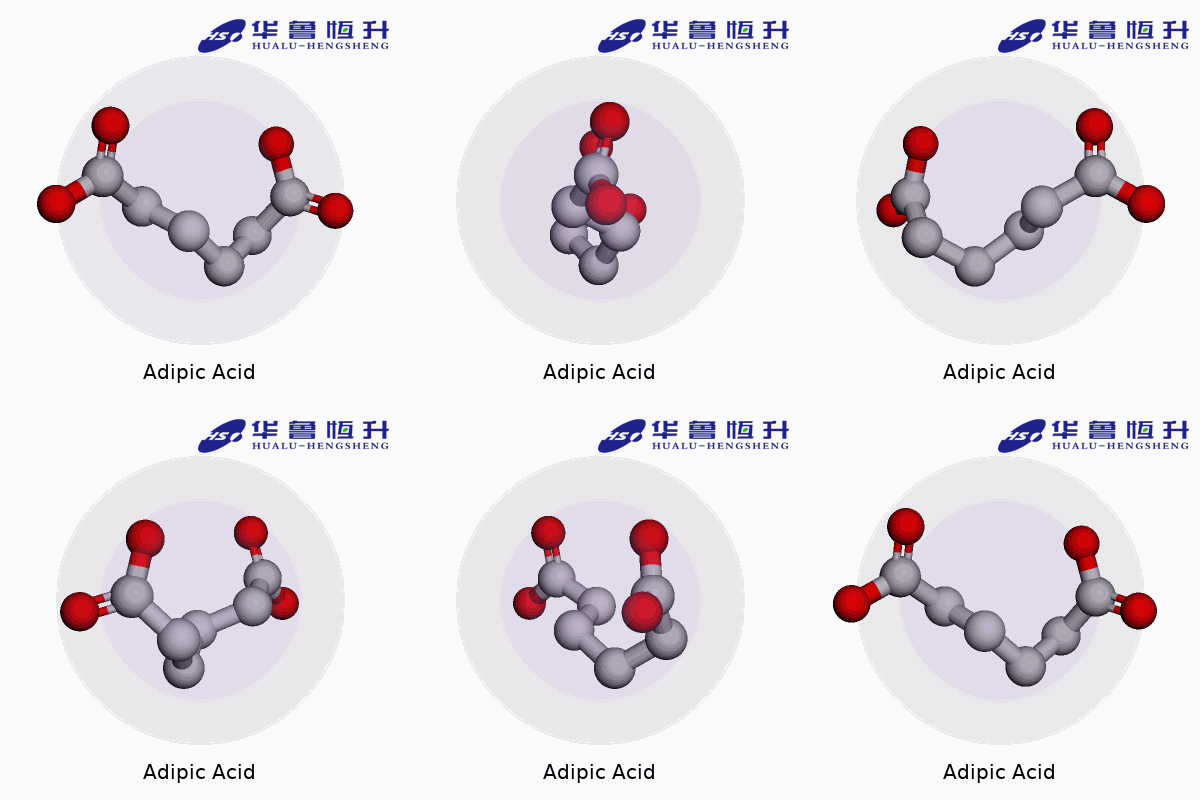
From my vantage point inside a chemical plant, adipic acid pops up everywhere: in the raw materials inventory, on production lines, in quality labs. Each drum or tanker of it holds the same clear message—a straightforward molecular structure, yet one that supports several high-value industries. Adipic acid is a dicarboxylic acid, meaning it contains two carboxyl groups. Its chemical formula is C6H10O4, and its structure, HOOC-(CH2)4-COOH, shows a chain of four methylene units connecting two carboxyl groups. Simplicity in structure does not translate to triviality in application, not when this compound anchors the nylon and polyurethane supply chains.
Working with adipic acid means keeping a close eye on purity. Contaminants, even trace levels, influence not just our process efficiency but also the mechanical properties of polymers downstream. Production in our facility follows a path of oxidation—cyclohexanone and cyclohexanol transforming into adipic acid under controlled conditions. Each batch cycles through reactors, crystalizing into white solid granules once cooling starts. This conversion gives us a high-yield, scalable process that matches global demand for polyamides and plasticizers.
The chemical structure of adipic acid offers flexibility for reactivity. Two carboxyl groups open doors for condensation polymerization. In the case of nylon 6,6, adipic acid meets hexamethylenediamine, water splits off, and strong polymer chains form. The toughness of these fibers owes much to that even six-carbon backbone. This same chemistry lends itself to polyurethane systems and to many specialty plasticizers in polyvinyl chloride applications.
On the floor, structure rules the day. The straight-chain configuration of adipic acid keeps reactivity predictable—a real asset during scale up or troubleshooting. Shorter dicarboxylic acids or branched variants won’t give us the consistent melt strength required by fiber producers. Only with the linear six-carbons do we achieve that fine-tuned balance between flexibility and rigidity. This impacts not just how well the products process but also how they perform in car air bags, carpets, engineered plastics, and coatings.
Molecule details drive more than just product design. In recent years, our teams have worked hard to curb nitrous oxide emissions during adipic acid synthesis. Traditional nitric acid oxidation steps can release this greenhouse gas. By understanding the reactivity at every stage—especially at the carboxyl groups and along the aliphatic chain—we adapt catalysts and introduce abatement techniques that reduce emissions and conserve more raw material.
Better control over the structure and purity of adipic acid gives us pathways for greener production. Some developers explore bio-based routes, starting from glucose or other renewable feedstocks. These processes still generate the same linear molecule—C6H10O4—but with a lower carbon footprint. Switching to such methods could enable our facility to tap new value streams, serve customers pushing for more sustainable solutions, and ultimately help reshape the markets that rely on robust synthetic polymers.
Adipic acid’s chemical structure may be simple, but its reach stretches across industries and into efforts for a greener future. Every innovation in production or application starts with understanding this core molecule—and ends with the products that shape daily life, from clothing fibers to car interiors.
Adipic acid stands as one of the mainstays in our plant. We make nylon, polyurethanes, and a range of other materials that touch daily life. The work runs non-stop, with teams watching pressure gauges, temperature profiles, and purity levels—cleaning up every batch through rigorous processes. Turning raw chemicals into something so useful asks for careful control at every step.
The journey often starts with cyclohexanol and cyclohexanone. We draw these from benzene upstream, moving through hydrogenation and air oxidation. The core reaction adds nitric acid to oxidize the mixture. By closely managing how nitric acid meets the cyclohexanol/cyclohexanone blend, we optimize yield and safety. Temperatures climb, and nitrogen oxides form—some volatile, some stuck as by-products that demand mindful handling. We monitor gases as part of strict safety programs to minimize escape into the atmosphere.
Anyone who’s spent a shift here recognizes this isn’t just about mixing chemicals. Operating at scale brings a sea of pipes, reactors, and safety interlocks. Our teams train hard, because a slip in temperature or mixing sequence could mean runaway reactions. Several tons of material flow through each reactor daily, so control matters. Our monitoring systems track every pulse and vibration—giving plant operators confidence that we work within the safe window.
Making adipic acid produces nitrous oxide, a greenhouse gas. That detail matters, because each molecule affects the world beyond our gates. We invested in catalytic decomposition systems to address this. These installations break nitrous oxide down into harmless nitrogen and oxygen before anything reaches the atmosphere. Not every plant adopts these tech upgrades, but regulations and conscience both point the same way. Each year, we track how much reduction we achieve and set higher targets for the future. It takes capital spending and commitment, but the results pay off in cleaner air and a clear conscience.
Price swings in benzene ripple through our books. Any volatility in upstream supplies pushes us to find new efficiencies. Improvements often come from heat integration—recapturing waste heat from one stage, recycling it for another. Years of running the plant teach that small gains in energy balance add up. Each cycle, we reclaim solvents and squeeze more usable acid from residual streams. Nothing gets left to chance, since every kilogram represents not just revenue but hard-won raw material.
There’s constant discussion about alternate feedstocks. Bio-based routes and low-emission chemistry make their way from lab scale to demonstration units worldwide. As the industry evolves, we keep sending teams to benchmark new methods and run pilot tests. We share results with trade groups and research consortia—real gains only come through collaboration.
For us at the manufacturing floor, commercial adipic acid isn’t just a product. It’s the result of years of process development, investments in people and technology, and an ongoing promise to operate responsibly in a rapidly changing world.