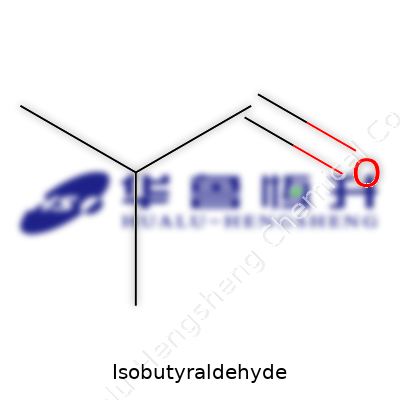
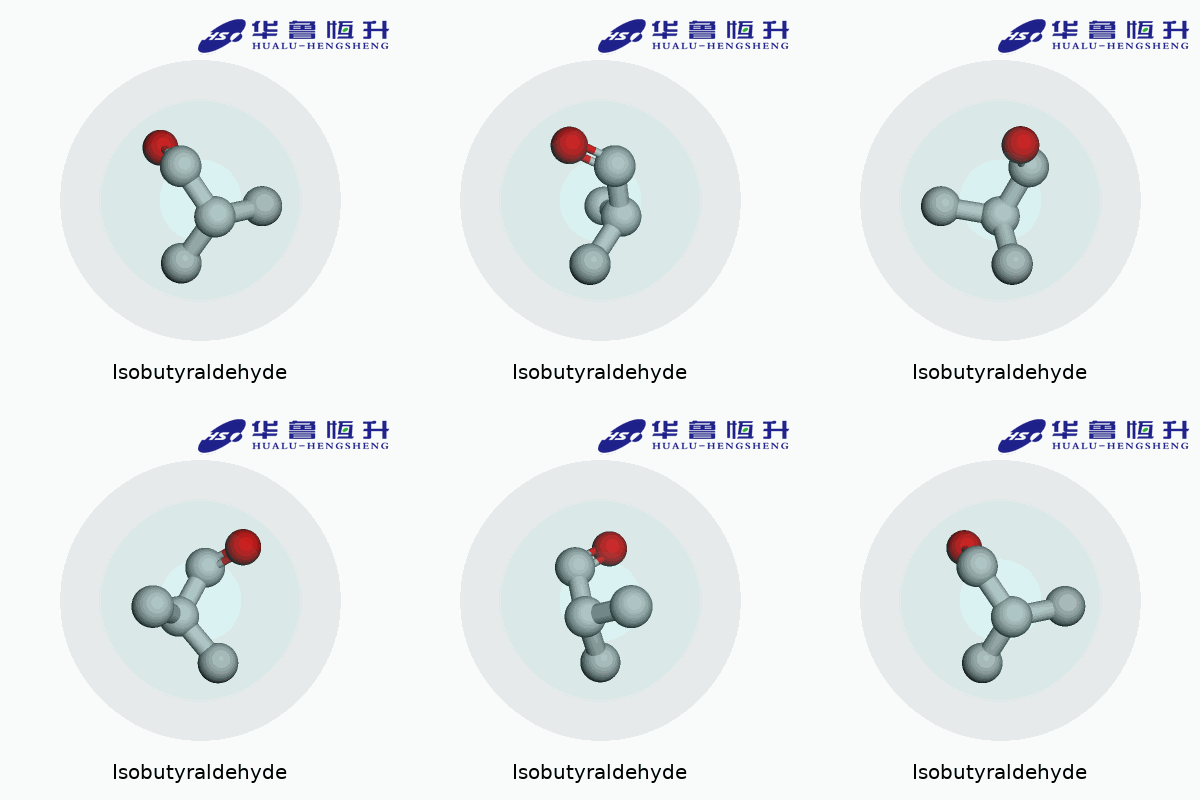
Chemical plants began producing isobutyraldehyde during the early expansion of the petrochemical industry as the demand for intermediates in organic synthesis started to climb. Chemists soon recognized its value as a building block, thanks to its branched structure which offered flexibility for downstream modification. Adoption gained speed once oxo synthesis; specifically, hydroformylation of propylene, proved efficient on an industrial scale. Over time, isobutyraldehyde found its way into portfolios across the globe, especially as industries chased higher performance plastics, coatings, and flavoring agents. Our own plant integrated continuous hydroformylation about four decades ago, moving from batch systems to a more sustainable, economically viable process. Line upgrades and experience with catalyst selection refined both product yield and purity. Shifts in environmental regulations meant investing in better containment and waste treatment systems as well.
Isobutyraldehyde is a key intermediate, primarily known for its clear, colorless liquid form with a pungent, sharp odor. Customers engaged in chemical synthesis expect high material integrity, which means maintaining low levels of water, peroxides, and side products like n-butyraldehyde. Our onsite analysts focus on consistency, recognizing that even small impurities can disrupt select applications such as pharmaceuticals or flavors. Our team monitors feedstock sources and halts production lines if off-spec propylene or synthesis gas reach the reactors, knowing rework wastes both energy and time. Downstream partners—those making plasticizers, for instance—count on tight quality control and rapid shipment, especially with limited shelf-stability for unformulated aldehydes.
Few chemicals offer the same balance of volatility and reactivity as isobutyraldehyde. Its boiling point hovers just below 65°C, which makes it easy to distill but also quick to evaporate if tanks aren’t properly sealed. The flash point sits near room temperature, so handling calls for effective ventilation and robust grounding to offset static and vapor accumulation. High vapor pressure means that storage always involves pressure-rated vessels and continuous monitoring for leaks, especially in summer months. Material compatibility reviews led our engineers to favor stainless steel and some high-grade polymers for gaskets and fittings, reducing maintenance and downtime over time. Experience with freeze-stat failures during cold weeks reminded the team just how sensitive it can be to low temperatures; the liquid solidifies at -85°C, so unheated tank lines spell trouble if ambient temperatures drop unexpectedly.
Our facility sets the minimum purity for outgoing isobutyraldehyde at 99.5% by gas chromatography, with aldehyde content as the key indicator. We also track typical thresholds for water (below 0.1%) and acid number, knowing downstream hydrogenation or aldol reactions stall in the presence of acid residues. All loading labels on drums and tankers describe the UN hazard class, packing group, and emergency response instructions, in line with GHS and DOT guidelines. Our logistics team includes an extra layer of traceability by tagging batch histories to all shipments, helping partners track lot-specific variances and streamline inventory reconciliation.
Hydroformylation continues to anchor our production. We feed high-purity propylene into plug-flow reactors fitted with a rhodium or cobalt catalyst system and regulated syngas streams. Temperature and pressure control remain vital, since catalyst deactivation accelerates with oxygen intrusion or over-temperature excursions. Our operators monitor both flowrates and feed ratios in real-time, relying on automated block valves and in-line chromatographs to spot deviations quickly. Once crude product leaves the reactors, distillation removes by-products and unreacted starting materials. The system generates a co-product, n-butyraldehyde, which requires separation given its different reactivity and uses. Periodic catalyst recycling and waste solvent management tie into broader site sustainability goals.
Versatility shapes isobutyraldehyde’s reputation across the industry. Hydrogenation, conducted at low pressures over standard nickel catalysts, transforms it into isobutanol—a key ingredient in lubricants and solvents. Base-catalyzed aldol reactions lead to diisobutyl ketone, giving the paint and coatings sector another valuable solvent. Upstream and downstream modifications often depend on keeping water out of the process streams; we learned through hard experience that just a trace can collapse yields or foul catalyst beds. Nitration, oxidation, and even Grignard additions point to new derivatives as demand for custom molecules grows in pharmaceuticals and agrochemicals. Outfitting the lab with microreactors let our R&D staff screen conditions with less risk and waste, a steady improvement over traditional bench-scale methods.
Precise communication in chemical manufacturing means mastering both formal and informal naming conventions. Clients may refer to isobutyraldehyde by its IUPAC name, 2-methylpropanal, or reach for synonyms like isobutanal and isobutyl aldehyde. Import paperwork and regulatory filings require careful coding across all synonyms, and our IT system flags variations to catch shipments headed to international destinations where nomenclature or customs rules may differ. Brand names rarely stick with a commodity as straightforward as isobutyraldehyde, but robust synonym tracking prevents delays and confusion across teams and customers.
Few aspects of production draw such sustained attention as safety. The vapor-heavy nature of isobutyraldehyde places priority on maintaining closed-loop systems with redundant leak detection. Regular line-walking and vapor monitoring stem from past incidents—small leaks can escalate quickly. Our emergency protocols stress proper ventilation, grounded pumps, and personal protective equipment meeting NFPA and OSHA guidelines. Spill containment zones around the production and storage areas isolate the material from stormwater run-off. Employees undergo annual training drills, focusing on both major releases and slower, chronic exposures. Onsite medical teams monitor for signs of aldehyde overexposure, such as respiratory irritation or skin inflammation, and company policy enforces immediate reporting and intervention.
Isobutyraldehyde’s downstream impact stretches wide. Production partners convert it into isobutanol, a favored solvent and plasticizer precursor. The fine chemicals market draws on it for synthesized flavors, perfumes, and specialty fragrances, since its structure encourages selective modification to create new notes or masking agents. Demand in crop protection chemicals remains firm; the molecule forms a basis for several modern herbicides and insecticides. Its role as a building block in amino acid synthesis feeds into both animal nutrition and pharmaceutical intermediates. Industrial customers in coatings and adhesives specify it as a precursor in making binders that withstand shifting environmental conditions. Years spent servicing a mix of multinational and specialty users shows the product’s flexibility, prompting us to keep both bulk and specialty grades on hand.
To keep pace with changing regulations, R&D teams target cleaner catalyst systems and waste minimization. Over the past decade, we’ve piloted low-cobalt alternatives and tested membrane technologies in separation stages, seeking tighter control on side product formation and lowering heavy metal use. Regular collaboration with university researchers helps us address issues like catalyst poisoning and raw material diversification. Modeling and simulation—powered by data collected from our plant’s sensors—guide many optimization efforts. Past projects focused on improving aldehyde stability in storage, leading to the adoption of inhibitor dosing systems and better inertial blanketing. Our innovation pipeline addresses efficient transformation beyond the traditional isobutanol route, exploring new specialties such as chiral auxiliaries and tailored surfactants.
Toxicological reviews confirm isobutyraldehyde’s acute and chronic exposure effects on both workers and ecosystems. The compound causes strong eye and respiratory irritation in humans, and ingestion or significant inhalation can depress the central nervous system. Our medical and EHS teams reference peer-reviewed studies and occupational exposure limits when setting policy. Bulk storage facilities use air-monitoring badges and periodic biological sampling to track exposure trends. Collaboration with environmental agencies keeps our team up-to-date on aquatic toxicity, especially since downstream residuals can impact water quality. Court-mandated remediation projects from the 1980s stand as reminders of the long-term need for vigilance both inside and outside the plant. Transparency, rapid incident reporting, and ongoing worker education remain central to responsible operation.
Regulatory tightening and sustainability targets frame much of the industry’s future planning. Bio-based feedstocks have moved from laboratory curiosity to practical scale-up conversations in boardrooms and engineering offices. Experiences developing new process controls around fluctuating biomass quality keep the whole operation nimble. Market interest in high-purity aldehydes for electronics and life science applications now spurs investments in next-generation purification and contamination monitoring. Automation and advanced analytics let operators spot trends in production jumps or quality deviations before they ripple into costly downtime. Research into new catalysts may eventually break dependence on rare metals and fossil-based inputs. Our own commitment to minimizing resource use and emissions drove a full retrofit of waste gas recovery units last year—an expensive move, but one we view as essential to keeping the business robust in an era of rising expectations from both customers and regulators.
Day in and day out, we start batches of isobutyraldehyde, keeping a careful eye on reaction temperatures and pressure. As a raw material, it finds its way into some of the most important downstream products in chemical manufacturing. Isobutyraldehyde has become a real workhorse across the sector, especially in the creation of isobutanol and neopentyl glycol. Our own output ends up in both small, specialized plants and large commodity operations, feeding into countless further transformations.
Let’s break it down. Most of our isobutyraldehyde serves as a building block for isobutanol. Isobutanol has a solid reputation as a solvent. It also plays a central role in the production of coatings, plastics, and even some biofuels. These applications rely on isobutyraldehyde’s reliable reactivity and clean conversion in oxo synthesis. We see steady orders from customers looking to expand their isobutanol lines, especially as demand for flexible solvents grows in step with global electronics and automotive industries.
Years of hands-on experience have shown that isobutyraldehyde doesn’t just drive other syntheses. It determines yield, purity, and efficiency in our batch and continuous processes. If we don’t keep impurities in check, end products suffer and waste rises. In our case, tight process control and high-purity distillation pay off both downstream and upstream in less rework, lower emissions, and happier customers.
More than half the isobutyraldehyde that leaves our reactors eventually plays a role in producing neopentyl glycol—another high-volume customer favorite. Neopentyl glycol, used in resins for coatings, paints, and even lubricants, depends on a steady, high-quality stream of isobutyraldehyde. That means every improvement to our own process directly benefits end users, enabling their products to meet growing environmental and performance standards. Our technical teams spend time working with end users, making sure each kilogram they receive supports their development and compliance goals.
Markets move fast. Recently, tighter environmental regulations raised the bar for byproducts and volatile organic compounds. Efforts to cut emissions have pushed us to rethink catalyst systems and upgrade recovery loops. Waste reduction and energy efficiency aren’t boardroom slogans—they’re part of daily decision-making in the plant. We rely on lean process flows and new control technology to meet internal benchmarks and regional standards.
Raw materials like isobutyraldehyde have an outsized impact on overall carbon footprint. As our own operation has adopted closed-loop solvent recovery and better heat integration, we’ve seen energy needs drop and cycle times shrink. Industry partners have started to ask for life cycle data and third-party audits. We support this shift, since transparency in sourcing and emissions directly ties to long-term business success.
Isobutyraldehyde is more than a link in the chain. For producers, every update—whether in process chemistry or safety systems—can ripple out to the whole value network. By continuing to invest in efficiency, safety, and tight quality control, we aim to keep providing a foundation for innovation throughout the industries that rely on this vital intermediate.
Anyone walking through a production plant knows how quickly the pace can shift from calm to controlled chaos. A tanker comes in, assays arrive from the lab, and the next formulation batch waits for its charge. In all of it, clarity over the chemicals at play isn’t just semantics — it’s the difference between a day running smooth and a headache nobody wants.
Take isobutyraldehyde. Its real, hard chemical formula: C4H8O. In manufacturing lines, that formula fits the backbone for thousands of downstream products, stretching across markets from agrochemicals to plasticizers and fragrances. Forget the textbook answers — a stray digit or letter and people get hurt, or costly mistakes get made. No plant manager signs off shipments without verifying the basics on compounds like this.
Translating a barrel’s label into a safe, efficient process ropes in several teams, whether loading pumps or tweaking reactor temperatures. Our chemists rely on that C4H8O to confirm the reagent's behavior matches expectations, especially in exothermic reactions. Shift workers have the MSDS and the specs drilled into their heads: misidentifying even a simple molecule leads to wrong dosages, unpredictable reactions, and system upsets in continuous facilities.
Knowledge of molecular structure shapes decisions when troubleshooting. Isobutyraldehyde, as an aldehyde, reacts vigorously with oxidizers. No operator wants to guess if a compound is a four-carbon molecule with a double-bonded oxygen, or if it strays further up the carbon ladder. The distinction goes way beyond routine paperwork. In process optimization meetings, we look at conversion rates, yields, and whether residuals line up with the chemical formula input. Downtime due to formula error racks up losses much faster than any price swing in the feedstock market.
Over years on the plant floor, patterns emerge in where misunderstandings creep in. Sometimes it's as basic as confusing isobutyraldehyde (C4H8O) with n-butyraldehyde, which shares the same atoms but a different structure. One slip in chain arrangement, product purity falters — we catch it with GC traces and viscosity checks. We’ve stopped tankers ready to unload for no bigger reason than a paperwork typo. Mistakes at this level spell trouble for the goods we supply to paint resin and pharmaceutical clients.
To keep things tight, our teams double-check chemical identifiers not just during purchasing, but as materials flow through storage, transfer, and blending operations. Digital systems back up human review. Manufacturers who trust only a printout fall behind. Those who train teams to recognize formulas right down to their implications raise the safety bar and deliver consistency batch after batch.
We tackle the challenge by running cross-department workshops on chemical identification and formulae. It’s not about memorizing lists. Practical exposure beats rote learning: seeing how C4H8O responds in different reactions, under different storage conditions, and handling requirements. Effective communication across the warehouse, batch room, and lab points back to everyone speaking the same language — one rooted in hard formulas rather than assumptions.
At the core, it’s about making sure knowledge turns into the kind of precision that keeps staff safe, customers supplied, and processes running. Clarity in the formula of isobutyraldehyde makes all the difference in the daily grind of chemical manufacturing.
Isobutyraldehyde stands as a core building block in our chemical business. We see its uses daily, moving from our reactors to downstream industries, on into food flavors, plasticizers, coatings. The talk about chemical hazards is often loaded with either alarm or apathy. We manufacture isobutyraldehyde, and we know the real risks and what it takes to work with this material in a safe and responsible way.
Ask anyone spending a shift near our tank farms—the sharp odor gives it away before you reach the production line. Isobutyraldehyde, a volatile liquid, isn’t one you want to inhale or spill on your hands. In our experience, workers exposed without protection quickly feel irritation in their respiratory system. We’ve had cases where eye exposure required rinsing and medical evaluation. Direct skin contact causes unpleasant irritation. Its volatility means workplace air quality demands serious attention. Management of vapor in enclosed spaces sits right at the top of our safety meeting agenda. Modern detection equipment, regular training, and quality personal protective gear form our backbone in reducing these risks.
Beyond the plant, isobutyraldehyde moves in drums and bulk containers. We watch its flammability—factory fires can devastate communities and families. Static discharge, equipment maintenance, and proper grounding keep us on our toes. We have invested in state-of-the-art ventilation and fire suppression systems. Any responsible operator recognizes these capital costs are not optional—they safeguard workers and neighbors. Accidents involving this chemical in transit almost always tie back to neglected basic controls.
There has also been a longstanding concern over its effects on health, especially for those working in manufacturing settings or handling it in large quantities. Exposure limits are in place for good reason. Regulatory guidelines stem from decades of toxicological research and industrial hygiene studies. In the manufacturing community, we lean on data from both government standards and the real-life observations of industrial physicians and safety engineers. In our experience, employees with effective respiratory protection, strict leak management, and diligent hygiene protocols do not develop chronic health problems connected to their isobutyraldehyde work.
No industrial material is inherently “safe”—it all comes down to disciplined stewardship. Even with our rigorous controls, we encourage an honest reporting culture. Incidents, near misses, even small leaks get documented for review and recurrence prevention. Routine health monitoring identifies early symptoms or overexposure long before things escalate.
Rigorous spill control, VEOC protocols, fast access to safety showers, and clear signage aren’t optional frills. Process upsets sometimes happen, even with years of experience on the line. We drill our crew regularly, so they operate from muscle memory, not confusion, when alarms sound.
Isobutyraldehyde presents real hazards to health when handled carelessly. Years of data, strict safety standards, and shared industry experience allow us to control these hazards and keep our staff and community safe. The key lies in vigilance, investment in safety infrastructure, ongoing staff education, and a company culture that prizes the health of its workers as much as its bottom line.
Every day in our production halls, isobutyraldehyde comes off the line in high purity. The compound’s distinctive, sharp scent floats in the air if containment ever slips. Years of manufacturing have taught us that how a material is stored changes everything, both for safety and maintaining product quality. Talking about isobutyraldehyde, a low-boiling point liquid with strong reactivity, experience leaves no room for shortcuts.
We rely on tightly sealed, stainless steel tanks for bulk storage. Steel offers resistance to the aldehyde’s corrosive tendencies. In a controlled factory, fumes never linger, as storage infrastructure stays rigorously maintained. Our loading points include proper pressure relief and nitrogen blanketing, reducing the risk of a vapor explosion. Nitrogen sits heavier than air and replaces oxygen, quelling unwanted reactions that could lead to fire or loss of quality.
Temperature control stands as a daily priority. Does it matter if the tank farm gets too warm? Absolutely. The boiling point for isobutyraldehyde sits low—less than thirty degrees Celsius. We’ve seen storage tanks approach unsafe pressures on summer days; doubling up insulation and ensuring proper shading reduces risks. Regular checks on building climate systems keep the temperature in line, rather than assuming automatic sensors will catch every spike.
Leaks go beyond regulatory compliance—they can cost lives and endanger the factory. A single valve left loose can lead to invisible vapor releases. Our facility schedules manual sweeps of all storage connections and gauges. Senior operators swear by handheld gas detectors and personal protective equipment. When the unmistakable almond-like scent appears, everyone jumps into action, checking for even minor breaches rather than relying on luck or purely automated systems.
Fire protection isn’t just sprinklers overhead. Halon and CO2 extinguishing systems line our storage areas, and separators keep the isobutyraldehyde isolated from oxidizers. Our internal policies match what OSHA and NFPA recommend because we’ve learned the hard way—risk multiplies with complacency. Spills or fires linked to improper storage don’t just destroy inventory; they tear through the trust built by years of careful operations.
Some colleagues in the chemical industry underestimate what isobutyraldehyde can do outside lab glassware. Paper guidelines are one thing, but they never replace training and real-time drills. We require everyone, even managers, to understand emergency response protocols, run evacuation simulations, and physically walk through the bulk storage site. Regular investment in tank upgrades and monitoring tech always pays for itself compared to the price of cleanup or injury.
These lessons stay with us: stainless steel storage, inert atmospheres, temperature control, proactive leak checks, and fire prevention measures aren’t up for debate. Each bit of vigilance and infrastructure directly protects workers, neighbors, and the business. That’s how we turn a volatile chemical into a reliable industrial building block—by giving storage the same respect as production itself.
Years of handling isobutyraldehyde on the shop floor give us a sharp view into what this molecule brings to the table. Our tanks fill with a clear, colorless liquid. Any worker walking through our aldehyde building will spot the thin, easily flowing character. You can pipette small volumes with ease – no sluggishness like you’d get in heavier organics. The sharp, pungent odor always announces a fresh batch; anyone who has spent time near the reactors knows when those fumes are around, and it means business. That smell, memorable as it is, signals the presence of carbonyls and points to the volatility engineers watch closely.
Isobutyraldehyde vaporizes fast. Its boiling point lands around 63 degrees Celsius. Even in a room anywhere near that, vapor pressure rises quickly and we have to keep lines closed and transfers tight to prevent losses and exposure. Workers watch sight glasses for bubbling. Through the winter months, condensation on storage drums sometimes points to temperature differences that drive headspace accumulation. The flash point, sitting below room temperature, means every production and storage area must treat this liquid with utmost respect for ignition sources. Static charges, open flames, or faulty motors need policing. This isn’t about running a lab; in the plant, a single mistake risks a flash fire or worse.
Out in the tanks, water intrusion is headache number one. Isobutyraldehyde mixes with water to an extent, but leaves two phases if you go too far. Every production shift aims for a dry stream, using good seals and nitrogen blankets. When water gets in, the separation is quick–lines cloud up and batches run off-spec. This is why we use stainless or lined vessels, instead of simple steel, which would corrode and drive up maintenance.
Our colleagues in downstream processing always stress temperature control. The low freezing point, well below zero Celsius, keeps it liquid through cold nights. Cool storage slows losses. But, exposure to oxygen and sunlight brings trouble too. Aldehydes like this one can form peroxides over time and that means careful attention to cleaning schedules and inventory rotation, not just keeping tanks full.
Those handling drums or process lines always use gloves and goggles. Even brief contact leaves an unpleasant sting on skin and eyes. Spill response teams practice regularly, using facts learned from previous near-misses. We don’t rely on textbooks—years of real-world handling shape our attitude: containment trumps clean-up.
Fast evaporation plays two roles in our plant. It helps in processes that demand quick removal, but raises emission control burdens. We install chillers and closed loading arms, not as luxuries, but to reclaim lost material and stay within regulated release limits. Engineers recalibrate detectors to match isobutyraldehyde’s sharp odor threshold; this brings confidence in leak detection.
The physical properties dictate how we respond to customer needs. For anyone scaling up, nothing replaces hands-on experience. Pumps that lose prime, seals that swell, and coatings that fail all trace back to these details. As manufacturers, each property of isobutyraldehyde shapes how we build safer, more reliable operations.