Melamine hasn’t just filled binders and countertops—it marks a turning point in industrial chemistry. Urea-based synthesis began more than a century ago, opening doors to entirely new classes of resins. The earliest production drew on deep expertise in ammonia and urea handling long before synthetic resin became a household name. Demand for stable, hard-wearing surfaces in the twentieth century set the stage for melamine-formaldehyde resins to take over in kitchenware and high-pressure laminates. Working through the postwar era, process designs grew more cost-effective, reducing waste and boosting purity. Over time, consistent improvement responded to both technical bottlenecks and the changing regulatory landscape. At our plant, a tour through old technical notebooks shows tireless improvement—not just in batch yields but in understanding how subtle factors shape the final product.
What practical experience teaches about melamine—beyond technical reports—is how often it bridges the gap between durability and affordability. Melamine brings rigid, colorless crystals ideal for pairing with formaldehyde. Our customers care about the final material’s strength, stain resistance, and smooth touch. Whether for high-luster panels or electrical insulation, the powder form fits diverse applications due to ease of transport and long shelf life. We still see melamine in markets ranging from wood adhesives to dinnerware, where the reputation for reliability can make or break entire production runs.
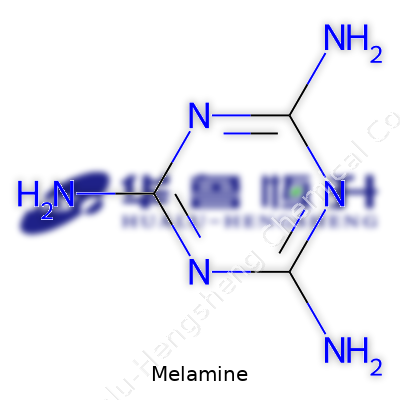
Melamine (C3H6N6) stands out not just for its chemical formula but for its utility on the factory floor. With a melting point above 350°C and very low solubility in water at room temperature, it brings substantial heat resistance. Handling it, you notice the fine, white crystalline powder flows smoothly from hopper to mixer, demanding proper dust control. Its triazine ring structure pumps up stability. Every shift on the line, technicians measure moisture to keep process consistency, since over-absorbed material can disrupt resin formation and foil an entire day’s production. Melamine’s moderate basicity means it can neutralize acids but also requires corrosion-resistant equipment downstream. Those years of hands-on production reinforce how these details influence every subsequent product step.
Standard practice in our industry calls for rigorous screening against purity benchmarks—generally above 99.8% for resin grade. Our quality lab crosschecks each batch for moisture, pH, color, and ash content, logging every result for compliance. Packaging shifts have evolved to address static buildup and caking, which threaten process continuity further down the supply chain. Our labeling doesn’t just spell out chemical details, but flags weight, lot number, and safe-handling guidance based on the lessons of actual plant incidents. Over time, these standards respond both to international trade requirements and safety protocols grounded in years of factory operation.
True efficiency in melamine synthesis comes from precisely handling urea conversion. Our reactors expose urea to high pressure and temperature in the presence of catalysts, forcing ammonia release and trimerization into melamine. Factory shifts obsessively monitor pressure gauges, keeping maintenance tight since any deviation saps yield and burdens waste treatment. The real breakthrough in operational history meant using off-gases efficiently and minimizing byproduct water, which can foul equipment or lower overall throughput. Our crew’s practical experience tells us that reactor balance and catalyst replenishment run vital for both quality control and environmental compliance.
Once synthesized, melamine demonstrates impressive reactivity with formaldehyde, which underpins its most famous use in thermoset plastics and laminates. In the workshop, we focus on controlling condensation reactions—temperature, acidity, and time—since minor tweaks reshape the resulting polymer’s hardness, water resistance, and flexibility. Melamine can also take on sulfonation or alkylation, which opens possibilities in new textile finishes and flame retardants. These chemical routes grow from both research and trail-and-error on plant floor, as we tinker with batch formulations to meet customer demands for impact resistance or electrical properties.
Over the decades, this compound has shown up in global commerce under several names—cyanuramide, 1,3,5-triazine-2,4,6-triamine, and just plain ‘melamine powder’ for everyday purchasing. Our packaging stresses technical grade, food contact potential, or resin suitability, depending on target sector. In the factory, names reflect not branding but practical differences—resin grade, glaze grade, or technical grade—with each tailored to downstream chemical compatibility or regulatory clearance. It’s details like these that separate true production expertise from marketing gloss.
Long-running operation means real-world safety concerns carry just as much weight as theoretical risks. Melamine dust poses an inhalation hazard if extraction systems falter, so every shift checks air handling systems, and teams wear fit-tested respirators during cleaning. Though acute toxicity appears low, cumulative exposure and potential contaminants compel careful handling. Spill drills aren’t just paperwork—they’re rooted in memories of line blockages or overfilled containers. We’ve invested in closed conveyance and dust-free packaging through hard lessons about static discharge or slip hazards. All training reflects what happens on the factory floor, not just checkbox compliance.
Textbook entries mention plastics, laminates, and dinnerware—factory knowledge fills in the real gaps. The highest resin volumes go into decorative surfaces for furniture or architecture, where resistance to stains and marks drives demand. Melamine-urea adhesives glue plywood and particleboard that end up in nearly every home or office. Electric equipment uses melamine’s dielectric strength to prevent breakdown. In agriculture, slow-release nitrogen fertilizers blend melamine with urea for controlled nutrient delivery. We also field inquiries from textile makers aiming for wrinkle-resistant or fire-retardant fabrics. Each sector raises unique quality demands, so production lines and technical staff must respond with calibration, product adjustments, and honest turnaround times.
Every few years, the push for environmental improvement changes the way we think about production and downstream use. Our R&D focuses on lowering process energy, adopting water recycling, and tackling formaldehyde replacement—major challenges shaped by hands-on trials and customer feedback. Some projects target finer control of particle size or surface properties, since even minor tweaks in dispersion affect performance in downstream coatings or composites. We’ve partnered with universities to find safer crosslinkers or develop greener catalysts. From inside the factory, real feedback from failed experiments and off-spec batches shapes R&D more than any outside consultant or paper study.
Decades of animal studies and real-world incidents have shaped the consensus around melamine’s toxicity. Ingestion carries clear risks—crystal formation in kidneys sparked by high exposures drew global headlines after food adulteration scandals. On the floor, that means rigorous testing for pure inputs and waste, and a hard line on separation between food-contact and technical grades. Our plant prohibits practices that could ever mix byproducts into any feed or edible product. Industry groups and regulators continue to update exposure limits, often restricting permissible migration into consumables far below levels with any known health effect. Training programs make clear that shortcuts or mishandling carry not just regulatory consequences but real harm. We track every ton from entry to delivery, conscious that consumer trust rests on our daily diligence, not just annual audits.
The future of melamine won’t play out just in better adhesives or harder dinnerware. As regulations tighten on formaldehyde, our ability to adapt process chemistry or find new crosslinkers becomes key. Markets in Asia and South America have driven both higher volumes and sharper competition, pushing us to lower energy costs, recover more unreacted feedstock, and shrink the environmental footprint. Circular economy models put pressure on both producers and recyclers to find ways to recover or reuse melamine-based products after decades in service. Our research teams continue searching for bio-based alternatives and next-generation flame retardant systems. At the ground level, real innovation grows out of practical plant improvements, operators’ tips, and direct customer engagement, more than abstract R&D cycles. Melamine’s story links material science and manufacturing experience—bridging the gap between molecular manageability and the world’s daily needs.
Melamine stands as a core chemical for our production team. We make it in-house from urea through controlled heating, which reshapes the molecule into a strong, stable powder or crystals. Chemists have worked with melamine for nearly a century, so it enjoys deep roots in the industry. The composition relies on high nitrogen content, which turns out important in many applications.
Inside our plants, we see the practical side of melamine every day. Most of the output turns into melamine-formaldehyde resins. These resins power the woodworking and construction sectors through laminates, molding compounds, adhesives, and surface coatings. A lot of home furnishings—like whiteboards, kitchen counters, or flat-pack furniture—would not hold up to daily wear without these protective surfaces. People appreciate scratch resistance and easy maintenance, not knowing that comes from our chemical processes upstream.
We focus on purity and quality since even small impurities in melamine can affect the clarity and strength of the resins it creates. Our technical staff monitor reactors and check each batch, because what leaves our gates will become part of countless household and retail items worldwide. Consistency here is no accident; it’s a product of careful attention to feedstock, clean equipment, and strict adherence to process parameters.
Melamine’s history includes cautionary episodes, particularly in food contamination scandals. We never support such misuses; adding melamine to food—so someone can fudge protein content tests—carries obvious health consequences. Our teams only supply melamine for approved industrial purposes, in compliance with strict quality controls and transparent records. Real safety builds on controlled production, reputable supply chains, and education for buyers about proper use.
Our operations regularly undergo third-party audits and government inspections. Melamine dust and smoke deserve careful handling, so all our packing teams wear appropriate protection, and our air filters remove particulates before air leaves the building. Manufacturing here is about more than filling orders—it means stewardship and standing behind every shipment’s quality and origin.
Every industry wants materials that can do more while using less. Melamine opens pathways for lightweight, fire-resistant panels in modern construction. Many automakers choose melamine resins for under-the-hood plastics that resist heat and abrasion. In public buildings, fire codes now ask for flame-retardant coatings and furnishings—we answer these needs by supplying properly stabilized resins and additive blends, developed hand-in-hand with downstream partners.
Science continues to refine our processes, making production less wasteful and reducing energy demand per ton of melamine. We pursue closed-loop water systems and energy recovery, based on real engineering feedback from our plant operators. Every efficiency gained at our site reduces the footprint of every end product using melamine across the globe.
Melamine drives problem solving in manufacturing, from durable surfaces to advanced fire resistance. Our job runs deeper than filling an order sheet—we supply expertise, reliability, and safe handling at every stage. As building codes, environmental rules, and customer needs evolve, we keep working to turn chemistry into practical, safe, and sustainable materials.
In the chemical industry, melamine resin gained popularity because of its hardness and ease in forming durable shapes for kitchenware. Our own facilities have been turning melamine into tableware for years. You pick up a plate that looks hard, feels light, and resists stains—odds are it started out in our reactors. People want dishes that last, so demand for melamine never truly goes away.
The question of safety comes up often, especially with news cycles focusing on chemical migration from food containers. With melamine, the real issue isn't about the resin itself, but what happens over time under heat and acidity. Under tough laboratory conditions—simulating acidic foods and prolonged heating—some melamine can leach out in small quantities. The facts from both European Food Safety Authority and the US FDA show that, for standard use (not heating with strong acid, not microwaving), exposure remains below established safety thresholds.
Our team has decades of hands-on experience producing melamine for direct food contact. Every batch of resin goes through quality control testing. We also send finished goods to accredited labs for migration analysis, especially after regulatory agencies lowered tolerable intake levels. In our facility, we never compromise on the purity of starting chemicals, as trace amounts of leftover monomers can sneak through if the team lets down their guard. Ensuring high conversion rates from monomer to polymer matters—less residual melamine means less to leach into food.
Every year, we field questions about whether "BPA-free" or recycled plastics are better than melamine. The choice depends on how consumers use their products and how much stress the item will see. Melamine stands out under normal use for strength and shine. Still, factory training hammers home the warnings about microwaves and exposure to harsh acids. Instructions on our packaging tell users not to boil or microwave melamine tableware for this reason, and we've written those warnings after test data, not guesswork.
Some stories about melamine come from abuses outside regulated foodware: the milk contamination crisis a decade back shows what happens when people use chemicals for the wrong reasons. The scandal tarnished public trust. In response, regulatory agencies set strict limits for migration levels and established new testing protocols. Responsible chemical plants stepped up, investing in batch tracking and batch-level documentation. For our part, every export shipment carries a compliance report, showing formaldehyde and melamine migration values.
We learned valuable lessons by following up on field complaints. Sometimes, poorly manufactured melamine ware with low curing rates found its way into circulation—usually from unlicensed operations using substandard processes. Items with a chalky feel or unhealthy odors signal incomplete curing and a potential for higher migration. Real manufacturers use high heat, extended cure times, and non-recycled starting material. These steps cost more but reduce user risk.
Reputable producers keep up with regulations and scientific advances. We read every new safety bulletin from government agencies and trade associations. If thresholds tighten, our labs push testing sensitivity further. Not every country enforces the same standards, but responsible manufacturing means meeting or exceeding the strictest levels.
Melamine foodware serves millions of homes, restaurants, and cafeterias. People expect it to be safe and durable at the same time. With thoughtful chemistry, carefully selected raw materials, strict process control, and honest communication about safe use, manufacturers can meet those expectations.
Producing melamine formaldehyde resins for over two decades puts us in a unique position to comment on the use of melamine dinnerware in the kitchen. The interest in whether these plates, bowls, and cups fit comfortably into microwave and dishwasher routines comes from customers and end-users alike. Questions usually surface around safety, durability, and what really happens during daily use. From our manufacturing floor, through the QA lab, to communication with international clients, we see the impact of these choices up close.
Melamine resin, once cured into dinnerware, maintains a strong, lightweight, and break-resistant structure. Our process yields a thermosetting polymer that resists chipping and absorbs little water. The resin forms a strong bond under high temperatures during manufacturing. This quality gives melamine dinnerware its reputation for longevity. Recent news stories question if people should heat leftovers on melamine plates in the microwave. Heating pushes the material beyond its original design. Melamine resin starts to soften under sustained high heat, usually above 120°C. Microwaves heat food unevenly, sending a plate’s surface temperature over this threshold in spots even with normal use.
Lab tests conducted for some of the world’s largest tableware brands show leaching of small amounts of melamine or formaldehyde substances when plates get subjected to repeated microwave exposure. Health agencies warn against this. Extended or repeated microwave use can degrade the material and shorten the item’s useful life. No responsible melamine resin maker will label their dinnerware as microwave-safe. We recommend consumers transfer food to glass or ceramic when heating in a microwave. This recommendation protects health and preserves plate quality, both in institutional food service and private kitchens.
Automated dishwashers challenge materials with hot water, detergents, and constant temperature cycles—conditions our QA labs simulate every day. Melamine resin’s chemical bonds withstand the detergents and alkaline conditions found in household and commercial washers. Plates, cups, and bowls leave the washer clean, bright, and undamaged if the cycle temperature stays below standard settings. The stability of melamine’s structure is why top restaurant supply chains choose it. Home users value how the plates don’t warp, craze, or bleach after repeated washing. Fading of surface designs may occur after many years, but this reflects surface wear, not chemical breakdown. Dishwasher safety comes from material properties built-in at the resin stage. Over 30 years of field evidence and accelerated ware-washing tests show that melamine dinnerware outperforms cheap plastics and saves money by avoiding breakage losses.
Most problems arise from confusion—or from failing to follow care instructions. Many consumers expect plastic tableware to behave just like glass or ceramic. Greater clarity from manufacturers and simple, accurate care icons on packaging remove doubt. We, as producers, push for transparent labeling and direct communication about safe use. The safety benefits come not only from the carefully formulated resin, but also from giving users the right guidance. No shortcuts in raw material selection or curing standards protect users as much as clear information and respect for recommended use. Chemical manufacturers, kitchenware brands, and safety regulators all play a role in making daily life just a little easier and safer for families, cafeterias, and restaurants worldwide.
Melamine stands out to anyone in chemical manufacturing for its valuable properties—strength, heat-resistance, and versatility. From laminates to dinnerware, lightweight coatings to insulation, these characteristics drive its widespread use. But headlines about melamine contamination remind everyone that chemical properties carry consequences beyond the factory floor. For those of us producing melamine, it’s impossible to ignore what can happen when this resin enters realms outside its intended uses, especially when it winds up in food or drink.
Melamine is a triazine compound built mainly for industrial purposes: creating resins, molding compounds, and construction materials. The core health risk comes not from everyday contact with melamine-based plates or countertops, but when melamine turns up where it doesn’t belong—in the food supply. Past events have shown that adding melamine to food or feed illegally to falsely increase measured protein levels leads to real harm. It is not a nutrient. It doesn’t get broken down safely in the human body. Instead, when consumed, melamine passes through the kidneys. If eaten in small amounts occasionally, most is excreted without damage. With repeated exposure, or in higher doses, trouble begins—primarily in the kidneys.
Melamine can combine with certain acids (notably cyanuric acid) to form insoluble crystals in the kidneys. These crystals can clog the renal tubules and lead to kidney stones, inflammation, and even acute kidney failure. Children are at greater risk, as seen during high-profile incidents where melamine-tainted milk sickened thousands and caused fatalities. Toxicity studies have tracked these effects, especially when animals or humans consume both melamine and cyanuric acid together, amplifying the risk. Symptoms in mild cases mimic those of dehydration or urinary tract irritation. In severe exposures, the damage becomes permanent.
Regulations continue to strengthen around melamine limits in food products. Manufacturers can help by investing in traceability, cross-contamination prevention, and regular auditing, especially for facilities producing both food-grade and industrial chemicals. In our own work, we maintain clear separation between processes for technical-grade products and those for indirect food-contact materials. Regular third-party inspections and batch sampling cut down on risk. Internally, our team receives ongoing training on contamination routes, reminding everyone of the gravity of even trace-level mistakes. These operational practices stand out as the best way to keep our melamine products from causing harm in food or animal feed chains.
It only takes one bad actor to tarnish an entire supply chain. Responsible melamine production means not only hitting high standards in our production areas, but also keeping channels of transparency open—admitting shortcomings, investing in recovery if issues ever arise, and committing to continuous improvement. Adherence to regulatory allowable intake levels for melamine in consumables reflects seriousness with which health authorities regard improper use, and manufacturers must support these efforts entirely. The focus here shifts from mere compliance to genuine responsibility; public health and the reputation of our entire industry hang in the balance.
By prioritizing safe handling, strict quality segregation, and aggressive testing, melamine manufacturers demonstrate that the pursuit of quality products need not come at the cost of human health. The lesson remains clear: Melamine’s promise only shines when matched by discipline and integrity.
Inside the plant, every batch of melamine formaldehyde resin comes with a certain pride. We know what goes into these products and the expectations customers bring to the table. Melamine dinnerware, trays, panels, and countless molded items all share a common trait: a hard surface built to last, but like anything, they deserve a bit of routine attention. Over years of working with these materials, a few cleaning habits have proven safer and keep melamine looking good while sparing its structural integrity.
For typical household messes—coffee rings, food residue, pencil marks—warm water and a mild detergent clean things up easily. Our resin stands up to repeated washes, but harsh scouring pads can dull the finish. Abrasives scratch the surface and, in time, create spots for stains to settle. Soft sponges or microfiber cloths remove debris without attacking the outer resin layer. In our testing lab, we confirm the impact of repeated cleaning: surfaces treated with stainless-steel scrubbers lose their gloss months ahead of those cared for gently.
Avoid exposure to strong alkalis and acids such as industrial oven cleaners or bleach solutions. It’s tempting to use powerful products for stubborn stains, but melamine molecules start to lose cohesive bonds under strong chemical attack. We’ve sampled items returned from cafeteria kitchens after detergent cycles run too hot or too long with alkaline builders, seeing the effect—edges turn chalky, sometimes the resin feels rough and dry to the touch. Keeping dishwashing temperatures below 70°C preserves the finish, as test samples clearly show less material wear at lower set points.
Melamine resists most typical staining foods, but tomato sauce, curry, and heavily spiced oils sometimes leave traces if not washed quickly. If a stain sets, a paste of baking soda with water clears much of the residue with gentle rubbing. We advise against soaking melamine products in colored liquids for extended periods—a lesson reinforced after seeing repeat purchase requests from institutional kitchens where discoloration builds up over hundreds of uses.
Direct contact with high heat proves another challenge. Melamine resin withstands brief heating, yet exposure to open flames, broiler elements or hot pans warps shape fast, leading to premature replacement. Some customers assume microwave suitability, but internal plant studies show localized overheating cracks the molecular network, creating permanent loss of strength. For stubborn stuck-on materials, submerging the product in warm soapy water loosens debris without resorting to force.
In our facilities, molded melamine clears final inspections based on both surface smoothness and mechanical toughness. But the real test comes long after packing, once dishes and panels face daily use. Storing items where edges don’t clip or drag maintains appearance. We’ve collected feedback from schools, care homes, and food halls who stack melamine too tightly, leading to chips that creep toward cracks. Thoughtful care, as simple as using stack pads or nested trays with cloth liners, holds off mechanical wear.
These products earn their reputation for resilience. From what we see inside production and in feedback from users, careful cleaning and avoidance of chemicals or excessive heat let melamine wares outlast alternatives—and give families, businesses, and institutions more years of reliable, attractive use.