N-Butyraldehyde began drawing serious industrial interest during the early 20th century when large-scale oxo synthesis emerged as a vital petrochemical process. The hydroformylation method, which uses propylene, carbon monoxide, and hydrogen over a metal catalyst, created a stepping stone for the aldehyde’s commercial production. This was an era driven by a rapidly growing need for new intermediates to support expansion in plastics, solvents, and coatings. Over the years, sustained investments into catalyst technology, especially with rhodium and cobalt-based systems, brought higher selectivity and output, bringing the global chemical sector to a place where N-Butyraldehyde readily supports downstream operations in dozens of product chains. From our manufacturing lines, we have seen how constant process refinement and the push for yield efficiency continue to define this chemical’s industrial journey.
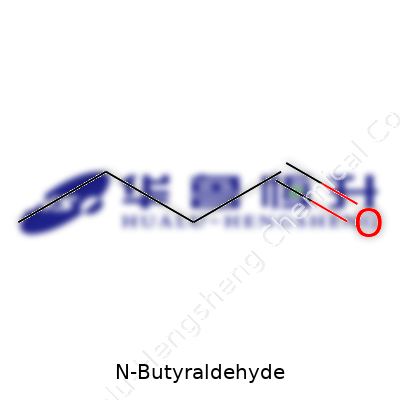
Our production of N-Butyraldehyde delivers a pale yellow, pungent-smelling liquid that stays in a volatile state under ambient conditions. The compound— also known as butanal— features a four-carbon straight chain with an aldehyde functional group. Essential as a chemical intermediate, it bridges upstream propylene feedstock and a wide range of downstream specialty and bulk products, especially alcohols, acids, and plasticizers. N-Butyraldehyde’s direct derivatives have secured vital roles in manufacturing flavorings, fragrance compounds, solvents, textile auxiliaries, and agricultural chemicals. Whenever demand spikes for 2-ethylhexanol, n-butanol, or butyric acid, our facilities ramp up to ensure a stable flow, because feedstock supply directly controls the reliability of these value chains.
N-Butyraldehyde boils near 75 degrees Celsius and carries a melting point around -96 degrees Celsius. Its notable low viscosity, high volatility, and solubility in most organic solvents, but not in water, form the foundation for process decisions during storage, blending, and transport. From a chemical handling perspective, the liquid easily evaporates at room temperature unless contained tightly. Reactivity comes from its aldehyde group, leading to robust participation in condensation, reduction, and polymerization reactions. Sensitivity to light and air, coupled with a flash point under typical warehouse temperatures, means operational routines must always center on containment and ventilation, as well as vigilant temperature control.
Stringent approaches to quality manifest in our finish product. Each batch undergoes gas chromatography analyses to check for typical purity exceeding 99 percent, and water content usually held below 0.1 percent. We use clear drum and ISO-tank labels that flag all hazards under GHS and regional chemical labeling guidelines. Key details include the substance’s UN number, chemical name, and hazard pictograms. By maintaining thorough analytical records and strict traceability, we can answer downstream customer questions swiftly, whether they relate to food grade applications, polymer manufacturing, or regulatory compliance with REACH and TSCA.
On an industrial scale, we rely on hydroformylation, where propylene reacts with synthesis gas under precise temperature and pressure, using a cobalt or rhodium catalyst. Achieving high selectivity toward the straight-chain product, as opposed to the branched isomers, takes constant adjustment of pressure, temperature, ligand protection, and syngas ratios. The byproduct n-butanol is often separated in the same unit, optimizing resource flows and minimizing energy input. Modern automation and in-line quality sensors allow us to detect process shifts in real time, so runoff and waste remain negligible, and the output meets strict downstream requirements.
Our N-Butyraldehyde supports a broad range of chemical transformations both within our walls and at partner facilities. In reduction steps, it produces n-butanol, a workhorse solvent and precursor for plasticizers like dioctyl phthalate. Oxidation transforms it into butyric acid, found in pharmaceuticals and food additives. Through aldol condensations, N-Butyraldehyde links with itself or other aldehydes to create longer-chain molecules for specialty uses. Under hydrogenation, it delivers intermediates for surfactant and detergent synthesis. Each of these pathways reflects its importance as a flexible anchor in chemical manufacturing, multiplying the utility of an original propylene molecule into stronger commercial value.
Within global commerce and among laboratory specialists, N-Butyraldehyde appears under several monikers. Chemists often use “butanal,” the IUPAC name, during academic exchange. In historical documentation, "n-butyl aldehyde" and "normal butyraldehyde" crop up, especially in older technical manuals. European labels still favor “butyral.” Whatever prefix appears on a bucket or drum, it points to the same high purity primary aldehyde that fuels polymer, fragrance, and solvent lines every day on our plant floor.
Safety is not just a compliance matter — it underpins long-term sustainability for every batch we produce. N-Butyraldehyde’s vapors irritate eyes, skin, and the upper respiratory tract. Liquid spills ignite easily and must not enter drains or open water systems, since aquatic toxicity presents a material risk for local environments. Our operations rest on closed-system pumping, explosion-proof lighting, and rigorously maintained ventilation. Routine fire drills, SDS refresher courses, and real-time atmospheric monitoring keep those working with and around N-Butyraldehyde within proven exposure thresholds. Continuous dialogue with workplace health authorities brings new PPE innovations and data on chronic exposure impacts, which shape both handling practices and plant redesigns. Risk reduction remains at the core of every production shift, and adherence to evolving national and international guidelines ensures we never lose sight of human or environmental wellness.
Almost every finished batch of N-Butyraldehyde moves downstream to become building blocks for plasticizers, especially 2-ethylhexanol, which supports cost-effective, high-performance vinyls. The flavors and fragrances sector relies on its aldehyde group to deliver complex top notes in perfumery and food aroma profiles. Farmers encounter its influence in the form of crop-protection agents and plant growth regulators, both active and intermediate. Solvent manufacturers value the compound for blending inks, resins, and cleaning formulations that meet modern standards for evaporation rate, solvency, and occupational safety. Beyond these sectors, biotech and pharmaceutical firms deploy it in process chemistry, where its reactivity allows modular construction of active functional groups. Each market presents its own regulatory, technical, and supply-chain hurdles, so cross-sector communication and technical support form a constant part of our daily manufacturing agenda.
Growing global demand drives continuous laboratory activity to raise throughput, lower energy use, and expand downstream applications for N-Butyraldehyde. Our R&D teams test new ligands and reaction profiles to lift catalyst lifetimes and selectivity. Digital plant models help us simulate dozens of process modifications before scaling up. New routes like biobased syntheses receive both funding and technical scrutiny, since renewable feedstocks could eventually de-risk the supply chain and shrink lifecycle greenhouse emissions. Analysts spend weeks tracking emerging regulations around trace contaminants and byproducts, especially for food and cosmetic ingredients, guiding changes to purification schemes, and prompting investments in new process analytics. By combining these technical advances with feedback from downstream clients, we develop stronger, more sustainable value networks—which give the chemical sector confidence that its backbone intermediates can evolve.
Scientists first recognized the toxicity of N-Butyraldehyde through eye and respiratory irritation observed in the earliest factory workers. Over the decades, controlled animal studies brought deeper understanding of acute and chronic effects, leading to the occupational exposure limit values used today. Metabolism and breakdown pathways show rapid conversion in the human liver, with excretion occurring shortly after exposure, but sustained vapor inhalation or poor ventilation can lead to measurable health impacts. In aquatic studies, the compound disrupts key biological processes in fish and invertebrates, so strict effluent controls define our wastewater protocols. Ongoing independent and in-house research tracks the compound’s behavior in complex environmental matrices and guides investment in safer containment, emission reduction, and cleanup tools.
Focusing our lens on the future, demand for N-Butyraldehyde will remain tied to expansion in vinyls, solvents, and agricultural intermediates. Alternative feedstocks, including bio-propylene and CO2-sourced syngas, are already on the horizon, and successful transition will cut the carbon intensity of each ton produced. Digital twins and advanced process control offer pathways to higher yields without compromising safety or product purity. Regulatory scrutiny, especially for residuals and emission limits, continues to evolve alongside consumer expectations — demanding more transparent supply chains, cleaner synthesis, and safer working environments. As a manufacturer, our role centers on technical competence, transparent communication, and shared commitment to chemical stewardship so every batch, drum, and downstream product stands up to both industry challenges and future opportunities.
As a manufacturer, I spend a lot of my time on the floor, watching the process churn out batch after batch of n-butyraldehyde. In all the years I've been involved in making this compound, I’ve seen where it ends up—and the sheer breadth can still surprise me. Most days, we load up tankers filled with clear liquid that’s headed to other plants, often just down the road, sometimes across the globe. It all starts in our reactors, but as soon as it leaves our gates, it’s the world’s raw material.
Ask anyone here, and they’ll tell you n-butyraldehyde mostly keeps us busy because of the demand for plasticizers. The vast majority flows straight into manufacturing 2-ethylhexanol, which eventually becomes those key ingredients softening vinyl or PVC that make up everyday items—cables, flooring, car interiors, swimming pool liners. Without a steady flow of these intermediates, the finished products would become brittle and useless quickly.
Solvents are another story entirely. Workplaces across the chemical landscape rely on coatings, adhesives, and inks derived from butyraldehyde-based compounds. Most never realize the connection; they see a painted wall or a label and move on, not realizing that one stable aldehyde molecule started the chain reaction some weeks or months earlier. It’s more than “just another solvent”—the reliability of the feedstock protects the performance and safety of thousands of consumer goods.
Anyone walking through our synthesis unit won’t get a sniff of the sweeter end of the chemistry, but n-butyraldehyde sits right at the crossroads for flavors and fragrances. We send a portion of our batches toward the production of butyric acid, itself known for its intense buttery note. It doesn’t stop there—secondary transformations generate ingredients in everything from baked goods flavoring to household perfumes. These applications might not take massive quantities, but they demand a rare consistency, purity, and reliability that can only come from tight control at every stage.
N-butyraldehyde isn’t the simplest compound to make. It demands vigilant monitoring, precise reaction conditions, and ongoing investment in process safety. We live with the responsibility every day. Mishandling poses health risks and environmental challenges, so most of our improvement projects focus on minimizing emissions, recycling solvents, and automating critical checkpoints. On top of that, stricter regulations keep us on our toes—governing not just workplace exposure, but waste streams and downstream product safety. Nothing in our operations gets taken for granted, from the feedstock selection to the final drum or tanker.
No one industry holds ownership over chemicals like n-butyraldehyde. Though certain markets spike demand—construction booms, automotive recovery, packaging trends—the core applications rarely change. Our technical teams spend time researching cleaner synthesis routes and waste valorization, hoping to keep pace with growing environmental awareness. We’re always asking: can the next generation of processes lower the carbon footprint and maintain the quality that downstream producers need?
What I’ve learned after years in this business is that behind every familiar product, there are layers of unseen chemistry, and n-butyraldehyde quietly anchors many of them. It rarely makes headlines, but without it, a huge number of everyday comforts would vanish from shelves. That’s why we keep investing, refining, and adapting—because our role doesn’t end at the production gate.
In our plant, N-Butyraldehyde has shown over the years that it rewards attention and punishes complacency. Its reactivity, volatility, and low flash point don’t leave room for error. Many who oversee similar production lines understand this well. The material’s distinct odors and its quick escape into the air make any lapse in storage or transfer obvious to all present. It takes only a minor oversight to set off alarms—with real consequences for safety, product quality, and regulatory compliance.
Steel tanks, closed to all but essential operations, prove their worth every day. N-Butyraldehyde vapors find the smallest openings; every flange, seal, and vent receives thorough sealing and regular inspections. Our tanks connect to vapor recovery systems, not just to protect workers, but also to address environmental concerns. Vent lines get routed to scrubbers or flare systems so that releases stay within regulated limits. This setup pays dividends during maintenance or bulk transfer, when agitation or temperature swings could otherwise send fumes into the plant or atmosphere. Closed handling methods also reduce the risk of contamination, so our reaction yields remain consistent.
N-Butyraldehyde’s flash point sits below ambient temperature much of the year. Even a warm day turns the material into an explosive hazard. Storage tanks live in cool, shaded zones and often use nitrogen blanketing. Moving it from tankers into storage—or between storage and process vessels—means grounding equipment, bonding connections, and double-checking that no sources of static stand near the worksite. We don’t take this lightly: before every transfer, operators walk through a checklist where skipping steps simply isn't an option. Doing so dramatically cuts the risk of fire.
Water spells trouble here; it reacts slowly with N-Butyraldehyde but can still cause problems downstream in chemical reactions. Desiccant breathers, regular tank cleaning, and tight gaskets keep moisture out. The oxygen-free environment also shields against unwanted oxidation, which can reduce shelf life and create hazardous byproducts. This isn’t about perfectionist habits—every missed detail can feed future process headaches.
Anyone who steps into a storage area receives hands-on training first. Fume hoods, splash shields, and vapor monitors go into operation every shift. Spills receive immediate cleanup, with absorbents and drain covers always close by. Some of us witnessed how fast small leaks can cause injuries or trigger costly evacuations, reinforcing a culture where shortcuts earn no respect. Respirators aren’t just a backup; when liquid lines disconnect or valves stick, we turn to PPE so everyone goes home healthy—no excuses.
Process teams learn early that running out of storage capacity, waiting on last-minute shipments, or letting old product collect in tanks never ends well. Inventory turns tightly track use patterns, with close coordination between logistics and plant operations. By building in buffer capacity, we sidestep surprises. This keeps everything running—regardless of shipping delays or weather.
Over the years, we’ve learned that vigilance outpaces even the best theoretical guidelines. It takes respect for the chemical, regular training, disciplined maintenance, and a willingness to invest in basic infrastructure. Only then can N-Butyraldehyde actually deliver on its promise—as a reliable raw material in anyone’s supply chain.
Working with N-Butyraldehyde, our team encounters a reality that goes beyond textbook instructions. The liquid carries a sharp, suffocating odor and causes noticeable irritation if it touches the skin or eyes. The urge to rush is strong during bulk transfers or line maintenance, but haste invites leaks and spills. Years on the job show us that clear process steps paired with the right gear—not shortcuts—prevent most accidents.
Standard practice calls for chemical splash goggles and gloves resistant to organic solvents. In our experience, nitrile gloves survive longer with N-Butyraldehyde. Full-face protection and long sleeves matter when hoses get disconnected or tanks are vented. Fume hoods or local exhaust draw vapors away at drum-filling stations. The difference is felt right at chest level—without exhaust, the air turns harsh and biting. Strict PPE routines mean that fewer workers develop sensitivities or respiratory issues over time.
N-Butyraldehyde vapors spread fast in enclosed spaces. We keep our storage and process areas under negative pressure and check ventilation fans weekly. Sensors near low points and valves catch leaks before the room fills with fumes. Physical checks still beat any automation—walking the floor, feeling for drips, and smelling for chemical traces highlight problems much sooner.
In a plant with moving pumps and mixing tanks, static sparks sneak up easily. Grounding straps on containers, floor mats, and proper footwear break the chain. We found that mixing metal and plastic piping without regular continuity checks leads to mystery shutdowns and, in rare cases, sparks. Training every new crew member on ignition risks stays at the top of the agenda. Even a tiny open flame or spark source near a filling rig can flash off vapor and trigger a fire. Keeping only the minimum inventory on hand lowers overall risk.
Spills happen, most often during hose changes or drum swaps. Prep stations with absorbent pads and bicarbonate-based neutralizers. Quick containment means less vapor drifting into adjoining bays. Emergency showers and eye washes within a short walk help personnel rinse off the chemical before burns set in. Posting incident procedures and rehearsing spill scenarios after shift changes turn a routine drill into muscle memory that saves real time during an emergency.
Safety procedures stick better with stories than forms. Sharing near-misses over morning meetings reminds us what can go wrong. New operators buddy up with veterans to catch bad habits early—complacency only sets in when eyes aren’t open. Refresher classes keep everyone sharp, especially when handling a chemical where the consequences of sloppy work show up fast.
Manufacturing with N-Butyraldehyde pushes us to respect the chemical’s hazards and lean into prevention. Each incident handled correctly builds a culture that values health over speed. Genuine safety doesn’t come from a manual or policy binder, but from crews taking responsibility—and learning from each shift.
The chemical industry leans on clarity when handling N-Butyraldehyde, and a straightforward question often pops up—what’s its chemical formula and what molecular weight are we working with? Every operator, from plant technician to process engineer, wants this information up front to keep process controls tight and safety checks solid. In our day-to-day, a misstep with basic physical information just isn’t an option, given how process stability affects both yield and safety margins.
You won’t find much mystery in the makeup of N-Butyraldehyde. The chemical formula is C4H8O. On paper, that comes out to four carbon atoms, eight hydrogen atoms, and one oxygen atom. The molecular weight runs to 72.11 grams per mole. These values set more than just the starting point for making calculations—they underpin the batching work in reactors and the analytical methods in the lab.
We’ve seen plenty of new hires try to approximate or rely on blurred recall for these basic details. In real production, that doesn’t hold up. Distillation columns don’t lie, and instrument calibration needs rock-solid references. A mistaken entry can cost an entire batch—no manager wants that conversation. Early on, supervisors drill into every trainee the importance of nailing these numbers. If the paperwork lists the wrong mass or formula, the end process can suffer from miscalculations in yields or even unexpected side reactions.
For those who work directly in fatty alcohol or plasticizer production, the details behind the numbers become tangible. N-Butyraldehyde’s formula impacts raw material selection, process heat management, and separation design. The molecular weight feeds directly into setting up the correct dosages during oxo synthesis or downstream reactions. If the feed line registers off-spec weight, detection flags trigger automatic shut-off, and the crew knows they’ve caught something before quality takes a hit.
One key lesson from years running reactors—molecular weights guide the stoichiometric calculations, not just for reaction efficiency but for emissions control. Vent gas calculations use input weights, and permit compliance depends on getting those right. The story repeats during maintenance: storage tanks and lines need sizing based on vapor pressures linked to N-Butyraldehyde's formula and molecular weight. When troubleshooting, experienced operators track back to these numbers every time a process shift happens. Any gap in understanding here puts an entire workflow at risk.
It’s easy to overlook just how foundational this data becomes across the supply chain. One time, quality control flagged a batch as out of spec. On investigation, a new software update had swapped in an incorrect molecular weight, throwing off all the material balances. Salvaging that batch meant tracing the source of error and reminding every team member why basics always matter, even in automated environments. Electronic records help, but human checks anchored in chemical knowledge remain essential.
Some newer teams might ask if software and automated sensors make knowing formulas or weights obsolete. Reality says otherwise. Each step in our chain, from purchase orders to delivery logistics, uses these core metrics as the backbone. Even for order fulfillment, loading crews calculate shipment volumes using molecular weights to ensure accurate delivery documentation. When an incident crops up—a valve leak, a reactive spill—first responders look for the correct formula and weight to cue up response protocols instantly.
For manufacturers producing N-Butyraldehyde, keeping clear on the chemical formula C4H8O and its molecular weight of 72.11 g/mol goes beyond textbook chemistry. Reliability, safety, and profitability all trace back to these fundamentals every shift of the year. It’s just part of doing the job right.
Years on the production floor show that dealing with N-Butyraldehyde goes beyond basic chemical handling. Its volatility means mistakes can lead to real hazards—fumes irritate, spills linger, and improper disposal brings regulators to your doorstep. Too many write about disposal in theory, but real consequences follow shortcuts or guesswork. Direct, practical knowledge about safe treatment counts for more than clichés or box-ticking. Every batch processed points to the same lesson: safe handling preserves people, property, and the wider community.
N-Butyraldehyde, a clear, flammable liquid with a strong odor, doesn't just disappear with a simple rinse or evaporation. From a chemical standpoint, it’s reactive—eager to form peroxides if left exposed to air—so mistakes linger long after cleanup looks finished. Its solubility in water raises another risk: pouring it down drains pushes contamination into water systems and risks violating environmental rules. Municipal wastewater plants cannot break it down effectively, leaving persistent residues that threaten local water quality.
In the plant, contained storage reduces exposure. Lined containers rated for flammable organics keep vapors from spreading. Segregated waste streams prevent incompatible mixtures that can trigger fires or runaway reactions. Every operator who fills a drum for removal gets regular training on the danger signs: overheating, bulging, or the sharp hint of butyric acid from slow breakdown. Specialized sorbents catch minor leaks, and ventilated storage rooms keep vapor concentration low.
Combustion under controlled conditions neutralizes N-Butyraldehyde effectively. Approved incinerators minimize emission risks and meet strict air quality targets, turning the material’s energy into heat instead of liability. Not every company has such technology on site, so partnering with licensed treatment facilities becomes the go-to solution. Certification guarantees they treat hazardous organics according to environmental law, so compliance stands up to inspection.
Large spills or outdated stock require tailored approaches. On-site neutralization with caustic solutions can break down residues, but only chemical specialists should direct these operations. Too dilute a remedy, and traces escape. Too strong, and secondary hazards like excessive heat or caustic mist emerge. For containers that held the substance, thorough triple washing and collection of wash fluids ensures no trace remains in the waste stream, preventing slow, unnoticed releases.
No story about N-Butyraldehyde disposal excludes personal protection. Gloves, goggles, and proper respirators shield workers from exposure, especially in hot or poorly ventilated areas. Simple steps like clear labeling and closed transfers stop mistakes before they snowball. In production settings near residential areas, responsible disposal reassures the public and local officials that manufacturing isn’t pushing pollution out of sight.
Every container sent for disposal carries a paper trail—shipping manifests, treatment certificates, and verified destruction records. This documentation protects the business against fines and proves care for neighbors downstream from the plant. Audits confirm nothing disappears without proper treatment, and records settle any claims about where chemicals ultimately end up. In this industry, cutting corners brings real costs, both financial and reputational.
Mitigating risk starts with good science, clear procedures, and persistent accountability. Each safe disposal becomes another reminder that chemical manufacturing gains its value not just from what gets produced, but from what never escapes confinement.