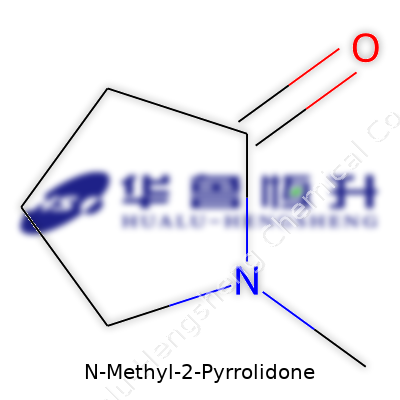
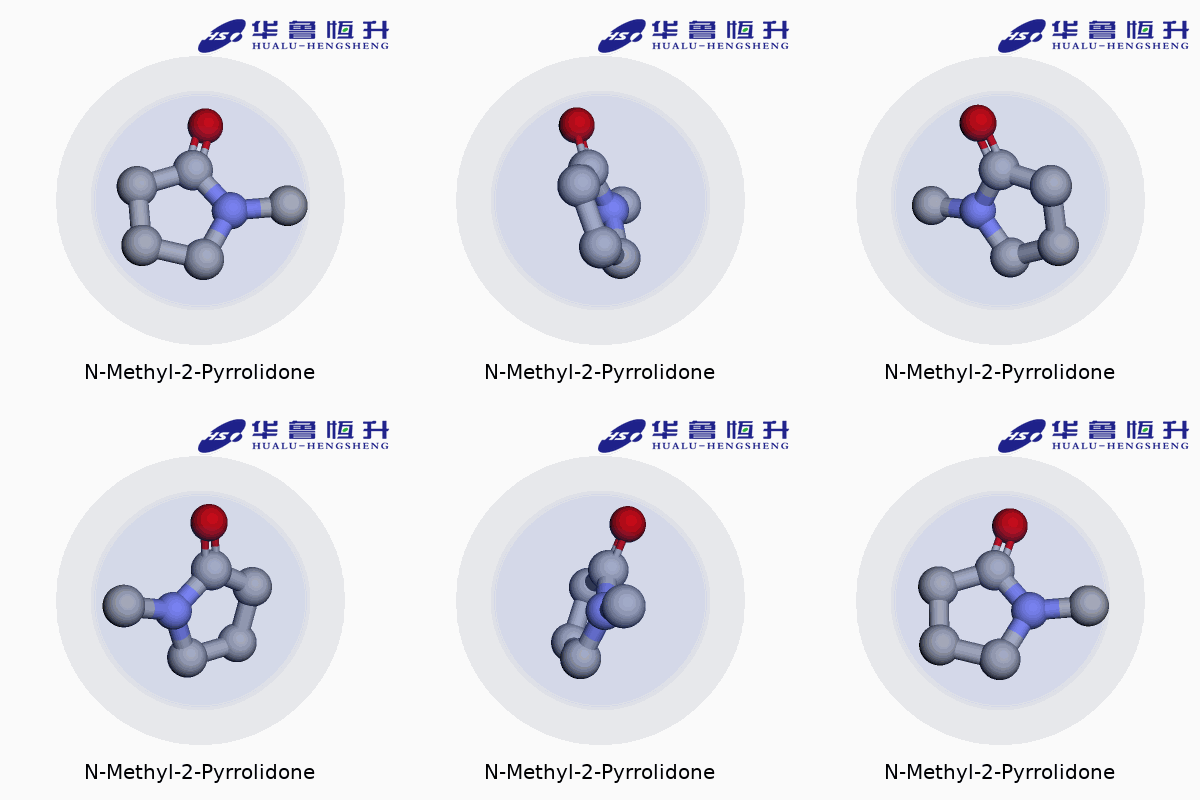
As manufacturers, we remember how N-Methyl-2-pyrrolidone (NMP) grew out of the surge in petrochemical research after World War II. The need for specialty solvents pushed researchers to look beyond basic hydrocarbons and alcohols. During the 1950s and 60s, teams explored cyclic amides and discovered that introducing an N-methyl group to pyrrolidone delivered a solvent with favorable polarity and compatibility. Over the decades, the industrial synthesis of NMP matured, leveraging butyrolactone and methylamine to produce consistent yields. As demand for higher-tech coatings, advanced polymers, and electronic processing increased, so did the need for high-purity NMP, driving improvements in both production and purification.
NMP serves as a powerful aprotic solvent with high affinity for a vast range of organic and inorganic compounds. Its miscibility with water and numerous organic solvents makes it indispensable in processes that require efficient solvency without supporting protic interactions. Our own systems rely on tight purity control because electronics and battery customers demand ultra-low water, chloride, and heavy metals. From removing paint, to making pharmaceuticals, to acting as a medium during polymer synthesis, NMP holds a versatility few solvents can match.
Manufacturers like us track properties such as boiling point, viscosity, vapor pressure, and solubility because they directly impact plant operations and end-use efficiencies. With a boiling point above 200°C and low vapor pressure at room temperature, NMP stays stable during high-temp applications and doesn’t evaporate easily. Its dipolar nature dissolves polar and non-polar substances efficiently, allowing us to use NMP in specialty resins and extraction processes. Physical clarity and lack of odor is always a priority, as purity issues can lead to material discoloration or off-odors in sensitive applications, such as pharmaceuticals or electronic substrates.
End-use dictates specifications. Manufacturers coordinate closely with customers to lock in tight thresholds for moisture content, acid value, color, and metal impurities. That often means distillation under controlled conditions and regular batch testing using gas chromatography and Karl Fischer titration. Labels must follow jurisdictional requirements, including hazard statements under GHS and REACH, UN numbers for transport, and batch-specific specification data, all aimed at keeping transporters, operators, and users informed and compliant.
The tried-and-true synthesis method in large plants involves reacting gamma-butyrolactone (GBL) with methylamine under controlled heat and pressure. Automated reactors allow for continuous flow regimes, optimizing reaction time and reducing by-product formation. Purification typically uses vacuum distillation to ensure high recovery and minimum residue, since trace by-products can impact downstream processes. Over the past ten years, process improvements—like real-time FTIR monitoring—have improved quality and reduced energy intensity, which matters for both cost and sustainability.
NMP acts as a solvent, reagent, or even as a reactant in certain modifications. Manufacturers pay attention to its behavior under strong acids and bases, as decomposition can produce hazardous gases. In our experience, NMP’s resistance to hydrolysis under neutral conditions enlarges its usefulness for extended reactions. Modifications often involve N-alkylation, ring opening, or derivatization to tailor the molecule for new applications, ranging from ionic liquids to special additives. Detailed process controls restrict the formation of N-nitrosamines, which can occur under some conditions and have known toxicity risks.
Over time, NMP collected a stable of synonyms which continue to appear in technical literature and supply tenders: 1-methyl-2-pyrrolidone, N-methylpyrrolidone, and N-methyl-γ-butyrolactam to name a few. Regulatory lists sometimes reference unique identifiers such as the CAS number 872-50-4. While marketing teams have tried to push house brand names in the past, the technical community still refers to NMP or 1-methyl-2-pyrrolidone almost exclusively.
From a manufacturer’s vantage point, NMP demands tight operational controls. Handling protocols are in place to mitigate acute risks of skin absorption and inhalation. Plants producing or handling NMP invest in closed transfer systems, robust air extraction, and chemical protective equipment for personnel. Many jurisdictions now impose specific occupational exposure limits; for instance, the European Union has recognized NMP as a substance of very high concern, prompting enhanced restrictions. Worker training, continuous air monitoring, and prompt spill cleanup procedures help avoid chronic exposures and environmental releases.
NMP’s performance supports its widespread adoption in electronics, pharmaceuticals, and coatings. In lithium-ion battery production, NMP dissolves PVDF binder for cathode slurries, and any substitution campaign must overcome both technical and safety hurdles. Drug manufacturers count on its solvency to enable demanding synthesis steps, especially those involving heat or stubborn intermediates. Paint and coating formulators need its compatibility to produce high-performance finishes. NMP’s use in plastics (notably polyimides and polyethersulfones) provides the backbone for membranes, specialty films, and wire enamels. Our own research and feedback from clients reinforce its central role, even under pressure from regulatory and consumer trends.
Ongoing research looks at greener or safer alternatives, but the challenge remains that few solvents match NMP’s unique combination of polarity, boiling point, and chemical stability. Some R&D pivots around process improvements—recovering solvent, reducing residuals, and enabling safer closed-system use. Innovations in downstream application, such as use in high-performance membranes or specialty composites, often draw from pilot trials using NMP as the solvent of record. Many technical teams explore selective purification to tailor NMP for microelectronics, where even parts per billion of impurity cripple device yields.
Manufacturers invest in thorough toxicological studies since legal and customer requirements continually raise the bar. Studies consistently find skin and respiratory absorption as key exposure routes and link broader worker safety concerns to chronic effects, especially reproductive toxicity. Regulatory reviews—from the EU ECHA to US EPA—monitor new exposure data and have prompted labeling changes, workplace limitations, and ongoing industry-supported longitudinal studies. The line between permissible and prohibited relies on balanced risk, so manufacturers commit to responsible communication, transparent labeling, and participating in multi-stakeholder risk assessments.
While NMP faces regulatory scrutiny, it remains difficult to replace across many chemical processes. Battery manufacturers in particular depend on it to deliver the performance needed for next-generation electric vehicles and grid storage. At the same time, the push for safer workplace environments and stricter emissions reductions challenge us to rethink how we handle, recover, and substitute volatile solvents. Investments in green chemistry seek to minimize risk through alternative solvents, process redesign, and better containment. The likely direction is not an outright replacement but smarter management, including purification and recovery, improved PPE, and closed-processing to safeguard both workers and the environment. Experts continue to explore chemical modifications to improve toxicological profiles without sacrificing solubility or stability, promising incremental improvements as large scale substitution proves challenging. For now, NMP stands as both a cornerstone of modern manufacturing and a test case for the entire industry’s adaptability to shifting regulatory and sustainability landscapes.
Ask any chemical manufacturer who’s handled N-Methyl-2-pyrrolidone (NMP). This solvent pops up in plants where flexible, tough performance is a must. At our site, NMP sees a steady flow from tankers to process lines, not because clients enjoy paperwork, but because it performs where water and alcohols fall short.
You’ll see NMP anywhere from lithium-ion battery cell factories to pharmaceutical lines and advanced polymer labs. Our operators measure out drums for resin production, then for cleaning, and later that same day, for electronics grade extractions. When a solvent can carry out reactions, dissolve stubborn resins, and still help keep reactors clean, someone’s going to put it to work every shift.
Lithium-ion batteries rely on NMP during electrode manufacturing. This isn’t a marginal application around the edges. In battery plants, NMP mixes with polyvinylidene fluoride binder to produce a thick slurry. Spread across current collectors, the binder needs to dissolve completely. Sub-par solvents just won’t do—any residual undissolved polymer affects battery life and safety.
We see orders increase from battery manufacturers each time electric vehicle demand spikes. They share clear feedback: no other solvent delivers the same balance of solvency and evaporation control. Large-scale facilities recover and recycle NMP with distillation units, knowing this efficiency slices costs and helps with compliance.
NMP acts as a mainstay in high-performance polymer synthesis, including polyimides and aramid fibers. During polymerization, NMP keeps things liquid and manageable—the reactors never seize up, and impurities wash out with ease during post-processing. People working with fine chemicals prefer NMP for the same reason: a consistent, reliable outcome and minimal downtime.
Pharmaceutical customers request NMP for specialty drug formulations and industrial-scale reactions. It dissolves a range of active ingredients, including some that barely budge in water. No one involved in drug synthesis wants to risk under-processed actives due to solvent constraints.
Paint and coating formulators lean on NMP for its strength against stubborn residues and its ability to create clear, uniform films. We ship NMP in bulk for both surface cleaner blends and as a carrying agent in high-performance paints. Workers prepping metal, plastic, or composite surfaces won’t accept streaking, slow drying, or residue—the risk of product failure on a customer’s site just isn’t worth it.
Regulators question NMP safety, so those of us producing, handling, and shipping it pay constant attention to exposure controls and worker training. Our manufacturing floor uses closed transfer systems, upgraded ventilation, and advanced PPE protocols. Customers ask about recovery systems, and engineers design continuous NMP recovery and reuse steps right into new lines. The chemical’s value hasn’t gone down, but neither has the need for careful handling.
As manufacturers, we pay attention to innovation in safer solvents and more efficient recovery. Current alternatives rarely match NMP’s versatility on all applications at large scale. Until something else works as well without drawbacks in cost or supply, NMP stays right at the core of industrial chemistry.
Working day in and day out around drums of N-Methyl-2-Pyrrolidone (NMP) gives a clear view of its role, risks, and rewards. Driven by actual plant experience, not theory, I can say this solvent matters a lot to the coatings, electronics, and pharma sectors. Its solvency strength and versatility keep many production lines running. But using it comes with responsibility, plain and simple.
Direct exposure to NMP causes practical problems. You can smell it in the air right away—a telltale, somewhat sweet but harsh odor. Frequent skin contact dries hands and leads to irritation. Long exposure, especially in warm process areas or if ventilation fails, means headaches and nausea are quick to follow. Health authorities have grouped NMP as a substance of very high concern. They base this on evidence linking overexposure to reproductive harm and possible effects on fetal development. This information is not theoretical. Colleagues who worked with open tanks before stricter handling rules can recall persistent coughs and rashes. Some even talk about fatigue that never quite went away, especially after long shifts in hot weather.
NMP moves easily through the skin and also lingers in poorly vented rooms. Being absorbed so quickly, routine exposure soon becomes chronic—not something to ignore. Years back, few wore gloves or full-face shields. Today, with tighter rules, wearing double nitrile gloves, lab coats, and the right respirator is non-negotiable. If a spill happens, clean-up must start straight away, and contaminated clothing can’t go home with anyone. No shortcuts exist when it comes to health. Our teams use local exhaust ventilation and air monitoring, because simply opening a door never clears away vapors fast enough.
Real improvements have come from listening to both science and workers. Plant managers started swapping open vessels for closed transfer piping. That simple step cut vapor risks by a huge margin. Automatic filling and draining setups followed, and put distance between people and liquid NMP. Nobody wants to see a co-worker rinsing splashed solvent off their arm. Over time, we introduced health monitoring programs—not just yearly checkups, but spot tests after any potential overexposure.
Some customers push for alternatives to NMP, and chemists keep testing replacements. In electronics, new formulations are showing promise, although they often require tweaks to the rest of the process. None have matched NMP’s dissolving power for every application yet. This puts the onus back on manufacturers to focus on risk reduction, just as much as on replacement.
In my experience, understanding both the hazard and the value of NMP is not a paper exercise, but daily reality. Everyone in the supply chain, not just the safety team, plays a role. Clear labeling, regular training, and fast response make the difference between a minor incident and a hospital visit. Rules exist for a reason, and in the NMP world, they’re drawn from hard-learned lessons. As long as we treat NMP with the respect it demands, while searching for safer solutions, the work can go on without unnecessary health consequences.
N-Methyl-2-Pyrrolidone, more commonly known by those of us on the plant floor as NMP, brings a lot to the table in the world of solvents. It’s a staple in everything from lithium-ion batteries to pharmaceuticals. Its chemical profile brings efficiency and consistency to manufacturing, but storing a substance like this calls for real awareness and discipline—something we work to maintain in practice, not just in paperwork.
NMP stands the test of daily operations thanks to its high solvency and stable boiling point. Complacency has no place in storage, though. We’ve seen what happens when a drum gets left exposed: water finds its way in, the product’s quality drops, and you’re looking at waste and downtime. So moisture management stays at the front of our storage strategy. Space stays dry and controlled, and we watch for condensation, which can sneak up with temperature swings. The stuff attracts water from the air, so even a small leak or open valve can spoil a batch.
NMP reacts with some plastics and rubbers. Stories on our site show what happens to gaskets and seals when you use the wrong material—swelling, loss of integrity, and, worst of all, leaks. Tanks and lines built from stainless steel or certain fluoropolymers hold up under daily contact. In the early years, we learned to avoid carbon steel through trial and error; even a few weeks’ exposure causes rust and gradual color changes in the product. Choosing the right construction materials protects both product quality and worker safety.
Despite a high flash point, treating NMP as a routine liquid opens the door to risk. Standard electrical fittings, grounded transfer systems, and proper ventilation turn out to matter more than most realize, especially during bulk transfers. Open containers multiply the risk of inhalation exposure. Crews use full-face respirators and chemical-resistant gloves. After watching a colleague develop skin irritation despite “quick” handling, no one here cuts corners on PPE.
Pallet racking keeps drums off the concrete, where sweating floors can accelerate external corrosion. Direct exposure to sun or heat can raise the product temperature, changing viscosity and consistency long before you notice by eye. Our best practice remains to store NMP in a well-ventilated, shaded warehouse, away from oxidizers and acids. We learned to keep a close log—tracking movements, incoming loads, and outgoing shipments—after a misplaced batch complicates batch traceability or shelf-life calculations. Even experienced teams benefit from visual labels and color codes to cut down the risk of confusion.
Regulators expect proper signage, secondary containment, and spill management tools. From experience, just checking a box on an audit sheet isn’t enough. Combining labeled containment trays with regular, real-world spill drills makes a difference when the unexpected happens. Our crew takes part in yearly refreshers, with lessons learned from small spills informing the next round of improvements. Even something as basic as walkways—kept clear, marked, and dry—helps limit slips or splashes, which cause more injuries than most outsiders guess.
Setting up reliable storage for NMP brings together chemistry, facilities management, and hard-earned lessons from years on the job. Attention to atmosphere, material compatibility, containment, and staff training protects both the product and those who handle it. For those of us making and moving these materials every day, safe storage goes hand-in-hand with operational pride and long-term customer trust.
Anyone who spends long hours working with N-Methyl-2-pyrrolidone (NMP) develops a practical respect for what this solvent can do—and just as importantly, for how it should be handled. Making and shipping NMP every day at industrial scale brings a straightforward perspective on what matters most: the health of the people who work with this chemical, the integrity of production, and the effect our operations have on our surroundings.
Those who’ve worked with NMP know that its strength as a solvent is the same quality that raises safety flags. The liquid penetrates skin easily, picks up substances others leave behind, and can carry them along for the ride. Prolonged skin contact can trigger allergic reactions, dryness, or lasting irritation. Keeping NMP vapor below established exposure limits prevents headaches, dizziness, and more severe health issues down the line. In our experience, relying on ordinary gloves or thin aprons only gives a false sense of security, especially when a busy production area puts pressure on quick batch processing or cleanup.
Not every glove works with NMP. We have found that nitrile, butyl, or laminated barrier gloves last longer against splash and hold up in continuous use. Vinyl gloves fall short and let the solvent through, usually unnoticed until somebody reports tingling or starts showing irritation. Face shields and snug-fitting goggles become part of the uniform, not for show but because we have seen what happens when splashes reach the eyes. Respiratory protection doesn’t just sit on a shelf “for emergencies”—the presence of vapor means regular testing, fit checks, and true accountability for every unit out of storage.
Our plants run robust local exhaust systems in every area where NMP gets opened or mixed. Simple box fans cannot pull vapors away fast enough to meet modern standards. Fixed hoods connected to scrubbers drive down airborne concentrations to safe levels, and we rely on air monitoring data to trigger action, not guesswork. Years of exposure data show that productivity stays higher, and employee turnover drops, in shops where air stays clean and breathable—even if the upfront investment stings.
We’ve seen the difference between one-time safety briefings and the kind of ongoing, hands-on training that sticks. Regular, mandatory sessions—where people hear real examples from our own line, see damaged gloves, or discuss actual near-misses—lead to behavior that protects both individual health and broader reputation. Early reporting of spills or malfunctioning PPE prevents problems from escalating. The real cost shows up when complacency sets in just because there haven’t been issues recently.
NMP does not evaporate into nothing or disappear down the drain. All waste must be sealed and labeled right at the point of creation—not “later in the shift”—to avoid accidents and regulatory headaches. Dedicated drums, double-bagged absorbents, and scheduled collections help prevent costly incidents.
Safe NMP handling starts on the manufacturing floor and hinges on real-world choices, not just rulebooks. Commitment from both leadership and every technician on the ground level brings about the kind of safety record that supports healthy operations for years to come.
From our view inside a modern chemical plant, N-Methyl-2-Pyrrolidone (NMP) isn’t just another item packed in drums and shipped off to distant warehouses. NMP finds itself behind the scenes in some of the world’s most high-impact manufacturing operations. It’s a solvent, yes, but what sets NMP apart lies in how it manages tough chemistry, particularly where other solvents show weak spots or safety issues.
Today’s electronics demand exquisite precision. We see NMP move quickly off the production floor into the hands of lithium-ion battery makers. Battery cell manufacturers lean on NMP’s power to dissolve polyvinylidene fluoride (PVDF) and other key binders in electrode coatings. Try working with electrodes for any major battery brand and you’ll see NMP’s fingerprints on production lines. Our operators have spent years tuning systems to keep NMP clean. Trace water or unwanted ions in a batch can kill yield for battery lines.
Circuit board makers also run our NMP through photoresist stripping baths. Year after year, it demonstrates an ability to remove stubborn, crosslinked residues without damaging the sensitive tracks below. This job pulls from our highest-purity grades, and many of our clients test every delivery to confirm solvent strength and purity remain stable.
Our technical support team fields regular questions from polymer plants. Polyimide film production, especially for flexible displays or aerospace wire insulation, needs NMP. We design reactors and pipes to withstand its strong solvency. Once polyamic acid dissolves fully in NMP, converters shape it into the base material for high-temperature films. Without it, some production lines face sudden shutdowns or expensive retrofits.
We’ve also seen NMP carve out a spot in the recovery and processing of certain hydrocarbons. Some gas sweetening operations select it because it extracts aromatics efficiently, even when feedstock compositions shift in unpredictable ways. This has strengthened its reputation in the specialty solvent world.
Pharma synthesis loves NMP for dissolving both polar and nonpolar compounds. We’ve provided product for labs scaling up challenging reactions; NMP’s stability under heat and reactivity in tough couplings helps projects proceed without costly delays. Regulatory trends keep us alert. Some clients demand documentation on impurities, or want help exploring alternatives as global health authorities study solvent residue limits.
Large paint remover or coating-stripping operations often turn to NMP. We have long-standing partnerships with customers looking for a fast, effective way to remove enamels, resins, or specialty coatings. Over the past decade, regulatory pressures have changed how and where NMP can be used. Still, for industrial stripping of bridges, trains, or aircraft, the chemists designing these formulations rarely skip NMP altogether. Our team keeps a watchful eye on both process safety and emissions; we regularly consult with clients about fume management, worker protection, and how to change their application systems for lower-volume, targeted use.
From inside the plant, it’s obvious that NMP serves as a backbone for industries where nothing else can compare. We face pressures: regulations grow sharper on worker exposure, and environmental standards push for safer alternatives or better containment. In response, we’ve upgraded handling systems, educated customers on personal protective equipment, and developed purification routes that reduce byproduct formation. We also support research into bio-based or recyclable solvents — including partnerships that might eventually replace NMP’s role. Until then, for many complex production systems, NMP remains hard to beat for reliability and results.