Manufacturers who work with succinic acid walk a well-trodden path. Succinic acid first drew attention in the 16th century. Chemists then distilled it from amber, and the old Latin word for amber, “succinum,” stuck. Hundreds of years later, the supply chain stretches wider and deeper, from coal tar in the 19th century to today’s petrochemical and bio-based feedstocks. Growing global industrial demand keeps drawing focus to succinic acid’s versatility, not only as an intermediate for specialty chemicals, pharmaceuticals, and biodegradable polymers, but also as a renewable bioproduct. What once rolled out in small jars from an amber still now pours daily by the metric ton, following strict protocols to meet today’s expectations on safety, sustainability, and traceability.
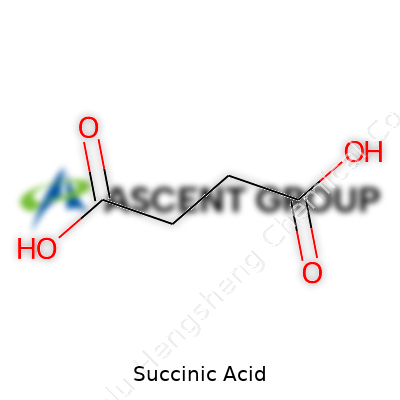
Succinic acid presents as colorless, odorless crystals, usually as a fine powder or granulate. Its structure—C4H6O4—boasts two carboxylic acid groups at each end, earning succinic acid a special status among dicarboxylic acids. That symmetrical structure promotes straightforward reactivity in both directions. Melting at around 185°C, soluble in water and most polar solvents, succinic acid proves stable under normal atmospheric conditions but decomposes when heated to decomposition. The acid titer and purity carry huge weight, and any deviation ripples through product application, particularly for customers demanding pharmaceutical, food-grade, or technological purity. Surface behavior, solution chemistry, and compatibility in downstream reactions all depend on fine control of these properties on every production run.
Years of hands-on compliance experience show that customers judge chemical quality fast. Purity generally exceeds 99.5 percent for most industrial orders, with tight controls on moisture, sulfates, heavy metals, and visual clarity. Dusting, caking, or inconsistent color throws up red flags about process stability. Labeling requirements stretch far beyond simple chemical identity. Rigid tracking includes lot numbers, regulatory symbols, and validated supplier documentation suitable for REACH compliance in Europe and comparable global mandates. Collaborative audits with downstream partners force producers to keep an ever-present focus on transparent, verifiable process control.
Early factory batches drew succinic acid from maleic anhydride through hydrogenation—simple chemistry, but a volatile reliance on fossil carbon. Grain alcohols, corn sugars, and even glycerol sidestreams now enter reactors as sustainable substrates for microbial fermentation. As the producer, pushing these bio-based methods means grappling with feedstock inconsistency, microbial contamination, and yield bottlenecks. Yet the upside—reduced carbon footprint, renewable differentiation, regulatory fast-track—tip the business case in favor of biotechnological advancement. Return on investment in continuous fermentation still demands skill, operational flexibility, and relentless process optimization.
Succinic acid’s pair of reactive carboxyl ends unlocks a toolkit for chemical synthesis. Its reactivity with alcohols forms diesters for plasticizers; with amines comes the foundation for polyamides and surfactants. Cyclization births succinimide, which finds use in pharmaceuticals and resins. Chemical producers often tweak reaction conditions—adjusting pH, swapping catalysts—to guide selectivity in downstream manufacture. The daily effort in the plant involves managing side reactions, greenhouse buildup, and process contaminants, keeping output clear for the intended modification route. Every shift in process chemistry brings fresh troubleshooting challenges.
Experienced chemical buyers, regulatory inspectors, and customs officials all refer to succinic acid by a handful of well-known names: butanedioic acid, spirit of amber, ethylenedicarboxylic acid. International trade tacks on the numbers—CAS 110-15-6 tells the global story in shorthand. Product naming precision cuts down on customs delays and regulatory disputes, keeping shipments moving for customers facing production deadlines. Even subtle confusion in product language complicates import or certification paperwork, so manufacturers maintain meticulous nomenclature across their documentation and packaging.
Safe operation shapes every batch produced. Even with low acute toxicity, succinic acid’s strong acidity can irritate skin, eyes, or respiratory systems. Production lines build in local exhaust systems, closed transfer, automated weighing, and point-of-use PPE protocols. Strict training, process checklists, and timely equipment maintenance help bring operational risks as low as reasonably achievable. Spill containment, environmental monitoring, and chemical-specific waste mitigation keep a tight lid on off-site risks. Operators, from plant floor to logistics staff, know that lax precaution can put both people and reputation at risk.
Product versatility supports the chemical manufacturer’s daily schedule. Food processors mix food-grade succinic acid as a tangy additive or flavor enhancer, benefiting from its GRAS status in many regions. Pharma companies require consistently pure input for active ingredient synthesis, buffer systems, and stabilizers. In the plastics industry, succinic acid-based polyesters, such as PBS or PBT, gain importance for biodegradable and biocompatible plastic options. Agrichemical and surfactant manufacturers rely on succinic acid’s chelating power, buffering ability, and mild acidity. Each industry partner brings unique demands for delivery form, packaging size, certification, and regulatory documentation.
R&D teams tackling succinic acid focus on boosting yield, curbing energy intensity, and unlocking new transformative chemistries. In-house pilot plants test continuous fermentation, recombinant microbes, and streamlined downstream purification. Collaboration with academic labs sharpens analytical techniques, terpenoid conversion routes, and catalytic upgrades. Process data gathered from every run feeds incremental improvements, from higher biobased titers to reduced impurities. The regulatory tide moves, too—projects increasingly focus on microplastic alternatives and robust sustainability certification systems.
Human and environmental safety testing keeps evolving, driven by stricter global standards. Acute toxicity runs low, though long-duration inhalation still raises occupational exposure concerns. Preclinical toxicology studies indicate moderate irritation levels, with little evidence linking exposure to chronic human health defects. Still, any process change undergoes scrutiny for potential metabolites or byproducts. Waste disposal demands careful neutralization and trace contaminant removal for compliance with both local and transnational environmental statutes. The industry learns rapidly from regulatory changes and the outcomes of longitudinal workplace exposure monitoring.
Demand for succinic acid points straight at green chemistry’s heartland. Bio-based production methods climb in popularity as carbon accounting and plastic regulation gain teeth. Industrial chemists search for new polymer blends based on succinic acid that promise compostability without trading off mechanical performance. Advanced catalysis and metabolic engineering look set to slash production costs and cut industrial emissions. With digitalization, process plants now collect fine-grained operational data, catching process drift early and keeping output steady. The chemical sector faces increasing customer scrutiny on product traceability, supply chain transparency, and environmental profile—all forces that drive real-world manufacturers to adopt cleaner, more accountable practices at every level.
Succinic acid isn’t just a name in a catalog. Every day in our production facilities, we watch this simple dicarboxylic acid transform basic feedstocks into materials and products that show up everywhere—from the shrink wrap on pallets in the warehouse to the ingredients list on foods in the grocery store. Our team puts a lot of energy into refining and purifying succinic acid because we know what’s at stake. Behind the spec sheets are years of experience working with customers who expect reliability and traceability with every shipment.
Food producers have long valued succinic acid’s tangy taste. It brings out sharper flavors in cheese, pickles, ready-to-drink beverages, and even coffee. In the controlled world of food-grade manufacturing, we remain vigilant about contaminants, as food processing partners expect nothing short of high-purity material. The ability to deliver consistent, clean acid directly affects consumer health and brand reputation.
Beyond the bite, succinic acid helps regulate acidity and stability in processed foods. Regulatory demands around food additive quality keep us on our toes; all our batches go through routine lab verification. Many food companies want assurance that succinic acid in their recipe lines up with every guideline. Trust grows when suppliers provide straightforward test data, not just assurances.
Polyurethane producers rely on succinic acid for polyols and plasticizers—a key part of foam seats, insulation, and piping. The chemical structure allows it to slot right into polymer synthesis, helping tailor flexibility and resilience. In our plant, we adapted reactor conditions over time to balance throughput with purity. This keeps us responsive when manufacturers make last-minute changes or call for custom runs.
Green chemistry now drives a lot of our research. Switches from petroleum-based routes to microbial fermentation happened after years of small-scale trials and tough conversations about cost versus sustainability. Buyers notice those changes. They ask about carbon footprint and production method, and our technicians answer with evidence, not empty greenwashing.
Succinic acid fills an essential niche in active pharmaceutical ingredients, where it often improves solubility or stability. The bar for quality rose higher each year, especially after tighter oversight in Asia and the EU. Our QA teams run extra impurity checks, knowing that a failed batch means delays or regulatory scrutiny. We’ve no shortcuts—we track every drum and keep full batch records.
In fertilizers, succinic acid influences soil nutrition and root development. Our agribusiness customers demand bulk supply and transparency. They push for steady pricing even as input costs change, so we routinely discuss hedging strategies and volume commitments.
Personal care formulators use succinic acid to buffer products like creams, toothpaste, and cleansers. Texture and shelf stability both benefit. We often collaborate on neutralization protocols. Sometimes we even help troubleshoot foaming or mixing issues on customer lines, since we know the behavior of our material inside and out.
Consistent supply depends on disciplined sourcing, robust process controls, and a culture of accountability in the workforce. We’ve made real investments in emissions controls and circular economy projects: waste capture, biobased process improvements, and partnerships with forward-thinking buyers. Succinic acid remains essential, but it’s the work behind the product that earns trust and long-term relationships. A reliable manufacturer’s job never stops at the shipping dock.
Succinic acid comes off the reactor line looking like any other organic acid — white crystals, hardly remarkable at first glance. Here in the manufacturing plant, everyone working on that process knows exactly how this compound ends up in food additives, supplements, and the pharmaceutical industry. You get a sense for both enthusiasm and skepticism in the outside world: some people see a promising ingredient, some just worry about safety.
Succinic acid isn’t new to our diets or biochemistry. It occurs naturally in many foods — cheese, sauerkraut, and mushrooms, for example. The citric acid cycle in every cell churns out succinate as part of normal metabolism. Our manufacturing process aims for purity far above what's found in any food. Most batches undergo multi-step purification, rigorous analytical checks, and regular monitoring for residual contaminants. These controls match or exceed food and pharma requirements in every market we supply.
Industry groups and regulatory agencies worldwide have studied succinic acid for decades. As a manufacturer, we review safety data from toxicology labs and human intake studies, and keep up with published scientific literature. The US Food and Drug Administration assigns succinic acid a GRAS (Generally Recognized As Safe) status for use in food. In the European Union, it's listed as food additive E363. Intake levels in foods and beverages remain well below any toxic threshold.
No manufacturing batch goes out without passing both in-house and third-party testing. That means checking for trace metals, microbial contamination, and byproducts from the production process. Staff undergoes regular training on food safety risk assessment. Customers demand clear documentation. Auditors can show up at any time; we do internal audits more often than that. Traceability extends from supplier raw materials down to packaged product shipped to formulators or bottlers.
Some manufacturers use succinic acid in powdered beverages for tartness, or in supplements marketed for energy support. Usage in food matches levels found naturally in cheese or tomatoes. Typical daily exposure through these products stays low, usually around a few milligrams. Acute and chronic toxicity studies — in animals and in controlled clinical trials — show no dangerous effects at these levels. Occasionally someone calls about an allergic reaction, but clinical literature has not documented any common sensitivity or intolerance. Succinic acid does not appear on allergen advisory lists.
Despite a strong safety track record, transparency matters. Manufacturers share safety data with food regulatory bodies, publish summaries online, and label end products in compliance with regional rules. Open dialogue helps address questions about ingredients, especially with new food trends or supplement blends. Quality programs keep suppliers accountable for their inputs. Digital batch records give traceability all the way downstream.
If people remain concerned about long-term safety, more research always helps. We support independent studies, especially those tracking evolving consumption habits or potential rare side effects that may show up only after years of dietary supplement use. Engaged customers and responsive manufacturers prevent misinformation from taking hold, ensuring trust in supply chains built on genuine, measured risk assessments.
Out on our production floor, succinic acid starts as an unassuming white powder, but its impact in modern skincare runs deep. We’ve worked with chemists who look at this molecule and see more than another additive. Its natural origin and skin-friendly activity have built a reputation that puts it on par with some of the industry’s benchmark acids.
Every week, we fill orders for skincare formulators fighting one big challenge: acne. Ask any development scientist who’s spent time troubleshooting breakouts—they’ll point to irritation and excessive drying as major setbacks with some traditional actives like benzoyl peroxide. Succinic acid gets picked up because it helps inhibit the growth of acne-causing microbes while remaining gentle on the skin barrier. We supply it to labs focused on formulating spot treatments that keep inflammation and flakiness under control. They want functional ingredients that deliver, not just buzzwords.
One trend we’ve seen accelerate is demand for mild, biobased acids that support sensitive skin claims. Salicylic and glycolic acids can leave skin stripped and tight, especially in leave-on products. Formulators using succinic acid often appreciate the moist texture it helps build into creams and gels. Its keratolytic properties support mild exfoliation, nudging dead cells from the skin’s surface without triggering the harshness seen with stronger acids. We’ve watched brands adopt it as a safer bet for those who react to more aggressive treatments.
Years ago it felt like only a handful of buyers really cared about origin. Now we receive detailed sourcing requests almost daily. Succinic acid lines up well here. We refine it through fermentation, usually starting from renewable feedstocks instead of petrochemicals. This gives brands a cleaner ingredient list and appeals to the "biobased" or "green" movement. Procurement teams want verification: they check lab results and visit our site to see the process in action. They tell us the story behind the ingredient is almost as important as the science.
Stability in formulations keeps R&D people awake at night. Some acids interact unpredictably, but succinic acid tucks into most water-based products without fuss. Its pH range makes life easier in production. We field questions from labs switching up their preservative systems or adding more actives, and many have found succinic acid doesn’t trigger breakdown or separation. We provide support on compatibility because wasted batches cost money and slow innovation. Seeing fewer failed test runs means confidence for both our operations and our customers’ launches.
Watch any product launch closely and you’ll see how often brands lean on scientific claims. Succinic acid gets real-world backing from research on its antimicrobial and mild exfoliating properties. As more developers look beyond the usual acids, interest rises in ingredients like succinic acid—solid performance, less risk of damage, plus traceable sourcing. We’ve built relationships over years with labs shaping tomorrow’s acne patches, cleansers, and overnight treatments. This kind of progress keeps us on our toes and moves the industry forward with every new batch we make.
Succinic acid doesn’t just come out of thin air—it takes work, the right setup, and good raw materials. On the factory floor, we use two main routes. The older method relies on fossil fuels, while the newer one chooses renewable feedstocks and fermentation. Each technique has benefits and limitations, so the decision depends on market demand, customer requirements, and local regulations on emissions.
We have always found the maleic anhydride route to be straightforward for producing substantial volumes. It starts with butane or benzene, which feed into the process to make maleic anhydride. Using one extra step—hydrogenation with a catalyst—transforms the maleic anhydride into succinic acid. This system works well for tight tolerances and consistent specifications. Still, it ties us to the price swings of petrochemical feedstocks and brings a significant carbon footprint. Many buyers demand raw materials with fewer emissions, and the traditional approach struggles to meet those expectations.
Decades ago, biotechnology was a small part of this discussion, but that changed as customers have asked real questions about where their chemicals come from. Our fermentation process has become a reliable alternative over time. We feed renewable sugars like glucose into tanks of specialized bacteria. Over several days, those cells convert the carbohydrates into succinic acid. This approach eliminates petroleum inputs and cuts down on greenhouse gas emissions. We see steady growth in buyer interest, not just among food producers, but also automotive and plastics companies searching for sustainable alternatives.
The bio-based route also challenges traditional cost models. Sugar prices fluctuate, fermentation takes time, and strains need careful engineering to keep yields high. Sterility must remain high throughout production. Even a minor contamination event can wipe out a whole batch, which sets us back both in terms of time and money. Energy use in downstream processing can rival the conventional route unless plant designers pay close attention to heat integration and water management. Our team constantly tweaks strains, tries new filtration and crystallization technologies, and pushes every variable to drive down costs per kilo.
We don’t see this as a purely technical issue. Customers want proof of origin, explanations about process waste, and data on total environmental footprint. Our buyers, especially from food and pharma, expect documentation and audits. The final product’s purity and traceability can make or break a business relationship. Fossil-based and bio-based acids perform the same at a molecular level, but the story behind each batch matters. Supporting the shift to greener methods isn’t just, in our view, about marketing or regulatory compliance. It’s about building trust.
Everyone working in this industry must balance efficiency, sustainability, and quality. Investments in better purification, creative biochemical engineering, and sharper process monitoring remain front and center in our operation. Succinic acid production may look simple on paper, but every day, it challenges our team to deliver what customers expect, both in performance and in social responsibility. As the pressure for sustainable chemicals grows, we keep our ears open and our processes ready for what comes next.
In any chemical manufacturing plant, folks deal with countless compounds, but succinic acid stands out for its simplicity and solid utility. The formula—C4H6O4—captures a lot of interest for its small size and versatility. It pops up in bio-based routes, petroleum derivate tracks, food processing, and pharmaceutical applications. Seeing it regularly on our production lines means recognizing it as a two-carboxylic acid: each end of that four-carbon chain features a –COOH group.
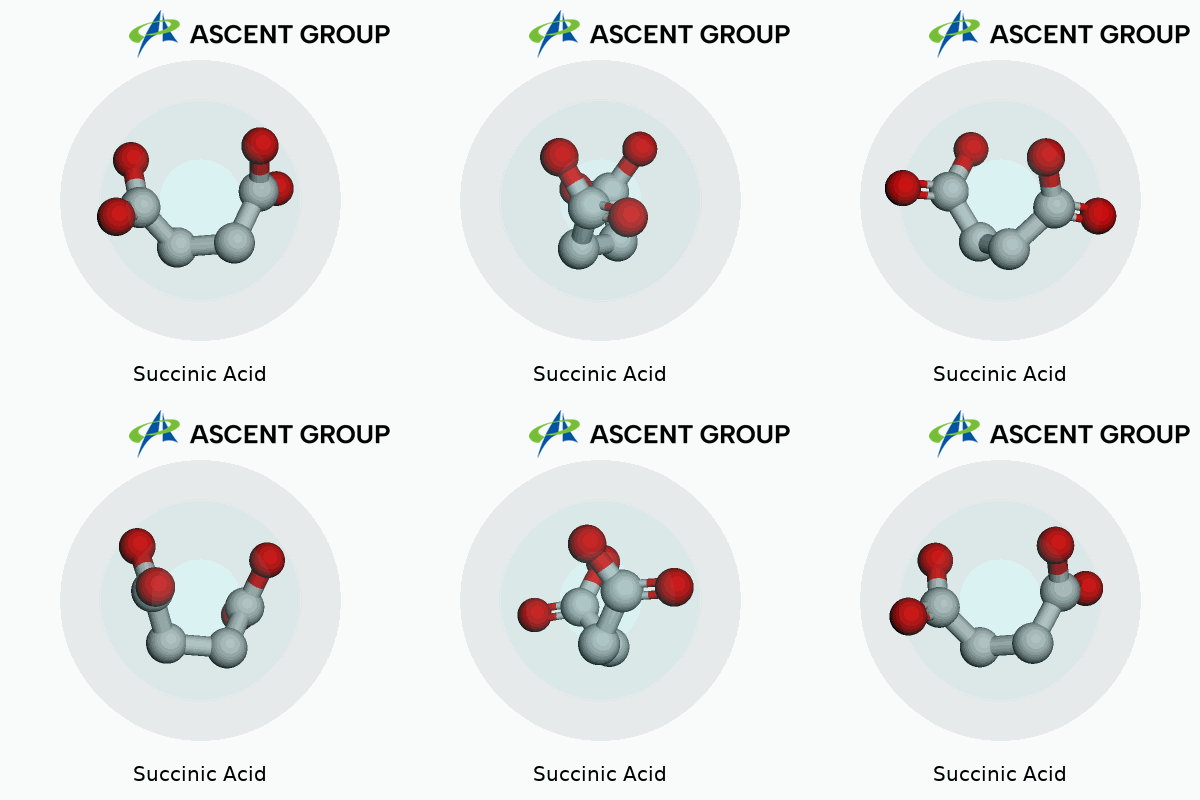
Years on the factory floor have drilled in the basics—succinic acid stretches into a neat, linear chain. Its official chemical structure can be laid out as HOOC-CH2-CH2-COOH. Four carbons, each connected in a row, two on the ends hold carboxylic acid groups, while the inner two are methylene bridges. That structure keeps succinic acid solid at room temperature and gives it predictable reactions, which plays a big role during synthesis. We monitor crystal form straight from filtration tanks—the colorless, odorless crystals always remind new hires that chemistry often values straightforwardness.
From our vantage point, the straightforward chain helps with process reliability. Succinic acid’s predictable melting and solubility properties make it easier to purify, recover, and scale up. Customers in food and pharma rely on this consistency, and plants like ours focus on controlling impurities—especially since two carboxylic groups offer ample sites for by-products. Handling this compound long enough, one realises how its linear design means reduced complication when running reactors, limiting unwanted side reactions. We’ve learned that managing the structure’s reactivity makes a real difference in minimizing waste streams and maintaining tight specifications batch after batch.
Sustainability teams in production environments care a lot about the C4H6O4 formula. Each carbon in the backbone could potentially come from renewable biomass—glucose, glycerol, or agri-residues—if plant operators select the right microbes or catalysts. This focus has become necessary as customers ask about carbon footprints and renewable origins. People on the plant floor see that the basic formula remains unchanged, no matter the feedstock. What’s under our control is the route to those four carbons and how many resources the process eats along the way.
One persistent issue involves keeping the two carboxylic ends fully reacted, free from impurities. Excessive heating, improper pH, or byproduct build-up can degrade product quality and complicate downstream processing. Real-world conditions don’t always match the theoretical ideal, so actual reactors and crystalizers call for vigilant monitoring, in-line sensors, and routine checks by experienced operators. Production teams often meet to review batch records and process deviations—invariably tied back to the basic C4H6O4 structure reacting in unexpected ways. Process chemists keep iterating on purification steps—active carbon treatments or re-crystallization protocols—so every shipment consistently meets quality expectations.
In daily practice, succinic acid’s structure and formula are more than textbook facts—they help manufacturers deliver quality, innovate, and cut environmental impacts. Its fundamental chemistry turns into practical protocols, reliable supply, and smarter sustainability choices, thanks to a clear understanding that’s shaped by years of real experience.