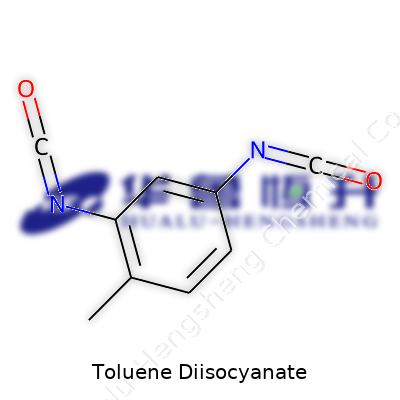
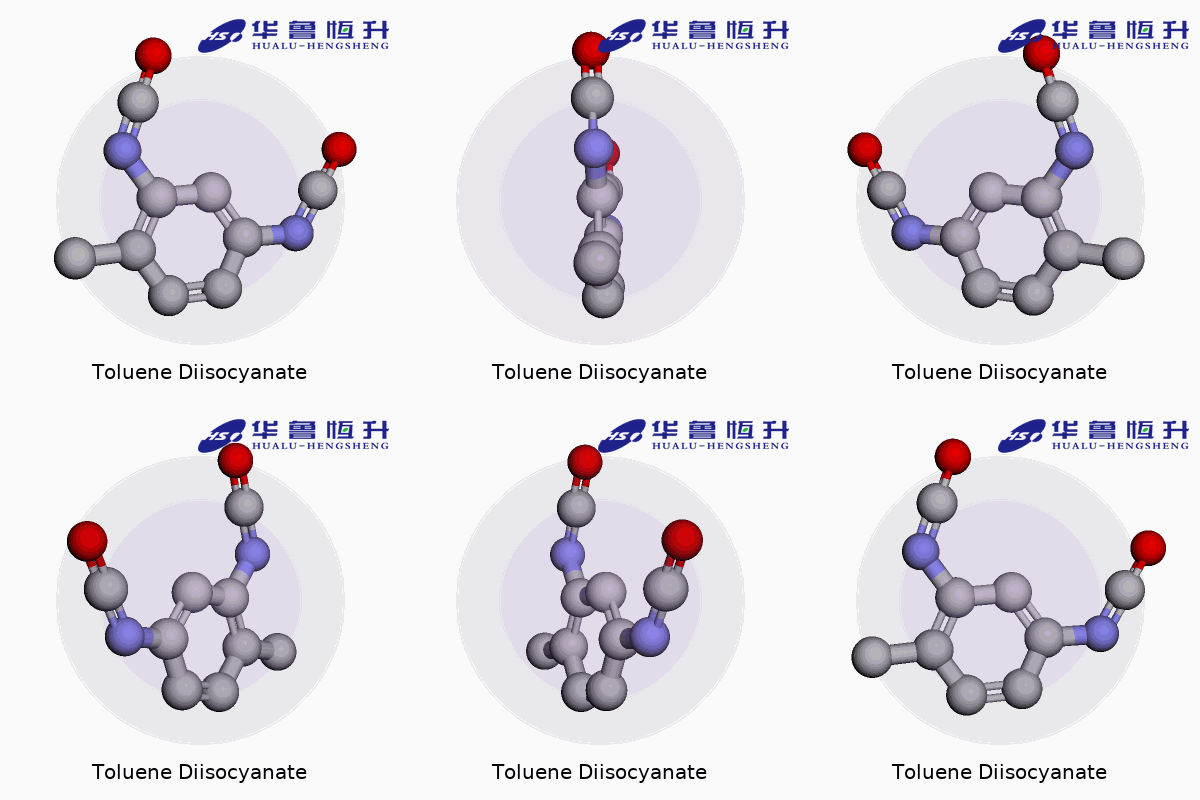
Toluene diisocyanate has been changing the shape of manufacturing for decades. Its origins trace back to the mid-twentieth century, branching from wartime research into novel polymers. The versatility of TDI, as we know it today, emerged from a push to replace and improve upon natural materials. Early breakthroughs in isocyanate chemistry opened the door for easier production of flexible foams, which quickly earned favor in mattress, furniture, and automotive sectors. In those early days, process control lagged behind current standards, and plant operators learned tough lessons about rigorous handling and atmospheric containment. Those years gave rise to many of the strict regulations and handling practices now considered the backbone of modern chemical management. Each piece of equipment in our facility—every reactor, pump, and vent scrubber—reflects lessons learned by generations who worked hands-on with TDI.
Toluene diisocyanate, often referred to as TDI, arrives in two main isomeric forms: 2,4-TDI and 2,6-TDI. Commercial production gravitates toward 80/20 and 65/35 blends of these isomers, the balance selected for mechanical properties in polyurethane formulations. As a manufacturer, we adjust process settings and feedstocks with great precision since purity and isomer ratio have a direct impact on foam physical properties. TDI’s significance grows clearer every day—no other material compares when it comes to balancing reactivity, processability, and final product performance in flexible foams. End users articulate their property wishes; we translate those requirements into chemistry on the plant floor.
As a pale yellow liquid at ambient conditions, TDI gives off a sharp, acrid odor. With its boiling point just above 250°C and vapor pressure of roughly 0.05 mmHg at room temperature, engineered controls must contain its volatility. Chemically, TDI is a diisocyanate: two highly reactive NCO groups anchored to a toluene ring. These isocyanates drive exothermic reactions with polyols, fueling the polymerization at the heart of polyurethane foams. TDI’s low viscosity makes for smooth handling in pipelines and reactors—process teams know how a slight bump in temperature alters flow rates and vapor emissions. Even seasoned technicians respect TDI’s propensity for rapid polymerization if contaminants such as water creep into lines, so plant design leans heavily on rigorous drying and inerting systems.
Specifications for industrial TDI go far beyond isomer content. Purity must run above 99%, with residual acidity, hydrolyzable chloride, and color all tightly constrained. Batch release hinges not only on chemical analysis but also on real-world trials: curing speed, bubble formation, and final product density. Labels detail UN numbers, hazard pictograms, signal words, precautionary statements—no shortcuts, as regulatory compliance and worker safety drive plant culture. Anyone who has spent time hauling TDI drums or loading bulk trailers will recall the physical reality of regulatory paperwork, training drills, and inspections, all rooted in historical incidents and evolving risk assessment.
TDI production depends on the classic phosgenation route, with toluenediamine (TDA) as the key precursor. In practice, TDA streams mix with phosgene under rigorous containment, driving the chemistry forward in well-sealed reactors. Carbon dioxide, hydrochloric acid byproducts, and unreacted phosgene pass through tailored separation steps, while care is taken to minimize phosgene emissions through comprehensive gas scrubbing installations. The yield and quality of each batch tie directly to the preparation procedure: optimal temperature, reactant feed rate, and solvent selection all impact safety and final product consistency. Years of running these processes underscore the need to keep equipment meticulously clean, as trace contaminants jeopardize reaction control. Stray moisture or amines can not only kill yields but also create dangerous exotherms.
TDI’s double isocyanate functionality positions it as a prime crosslinker in organic synthesis, especially with polyols. Generation of polyurethane foams dominates its application space, but its reactivity doesn’t stop there. TDI can link with amines to form ureas, open up transformation with alcohols into urethanes, and bind chemically with acids. Inside the plant, those same features that endear TDI to product development teams can turn a maintenance slip into a logistical headache—solidified deposits clogging a valve illustrate the ever-present demands of vigilant process management. Recent research efforts have focused on ways to moderate TDI reactivity with new catalysts, offering plant teams tighter control over foam structure and minimizing unwanted side reactions.
In the field, TDI carries many names—Toluene-2,4-diisocyanate, Toluene-2,6-diisocyanate, and various codes from manufacturers worldwide. Specific grades sometimes appear under proprietary product names, reflecting adjustments in stabilization, isomer content, or purity. All those synonyms stand for the same potent, widely recognized chemical prepared to stringent industrial standards.
Few chemicals command such respect on the plant floor as TDI. Worker protection shapes every facet of production, storage, and transport. Operators don full protective equipment—chemical suits, gloves, and positive-pressure respirators. Every new process technician absorbs in-depth hazard training, learning to spot leaks or irregular venting before a release escalates. Air monitoring pervades production halls, and emergency response drills move beyond theory. A single misstep can force an evacuation and trigger environmental remediation efforts. We have faced audits from regulatory agencies—OSHA, EPA, REACH, local and national bodies—each pushing for tighter limits on exposure and environmental release. As research strengthens the links between TDI exposure and respiratory sensitization, workplace controls only intensify. Routine medical surveillance and regular engineering reviews reinforce a safety mindset deeply embedded in daily operations.
Nearly every foam cushion, mattress, automotive seat, and insulation board starts with TDI at its chemical roots. Flexible slabstock and molded foams form its largest users, but coatings, adhesives, sealants, and elastomers (CASE) all tap into TDI’s reactivity. Customers across construction, transportation, and consumer goods sectors push for lighter, more resilient products. We field technical questions daily—how to tweak foaming profile, dial in resilience, manage emissions in hot climates. The underlying chemistry hasn’t changed, but customer needs get sharper every year. Engineers and scientists on both sides of the fence work together, experimenting with TDI/polyol ratios to hit increasingly ambitious performance targets. Market shifts toward comfort and sustainability echo back to the production floor.
Continuous improvement in TDI chemistry rests on deep partnerships between manufacturing and R&D. Decades ago, foam collapse or discoloration frustrated entire production shifts; today, data analytics and small-scale pilot plants make process optimization routine. Research teams probe for novel catalysts, better stabilizers, gentler curing regimes. Industrial plants mirror these advances, shifting blend ratios and applying automation to maintain consistency from tank farm to finished product. We run annual trials—new grades aiming for better emission profiles or reactivity tailored for demanding automotive cushions. Some of the most crucial innovations emerge from close feedback loops with end-users: their field failures, process bottlenecks, and unspoken needs drive the search for the next improvement. New attention falls on alternative precursors and greener process routes, amplifying our role in both commercial and environmental stewardship.
The reality of TDI’s toxicity sits firmly at the crossroads of product utility and occupational health. Industry and academic studies confirm inhalation or dermal exposure can cause respiratory sensitization, asthma, and skin irritation. Long-term studies reinforce the imperative of airtight engineering controls, rigorous personal protective equipment policies, and relentless monitoring. Regulatory exposure limits drive plant design, automation philosophy, and maintenance schedules. We work tightly with local authorities, occupational physicians, and researchers to track evolving toxicological data. Whenever new findings surface, operating procedures, training, and monitoring programs respond accordingly. Manufacturers with real-world experience know that early detection systems and transparent incident reporting underpin both regulatory compliance and employee trust.
TDI’s future weaves together market forces, regulatory trends, technological innovation, and a rising call for safer, greener chemistry. Growth in the furniture and automotive sectors continues to support healthy demand, while consumer awareness and evolving regulations steer the industry toward lower-emission and less hazardous alternatives. Plants invest heavily in waterborne technologies, substituting portions of TDI or developing novel isocyanate-free chemistries for next-generation foams. New catalyst platforms, smart plant automation, and expanded process analytics offer sharper control, minimizing off-spec material and reducing waste. Experience has taught us that tomorrow’s success depends on unrelenting attention to safety, deep investment in process improvement, and a willingness to adapt as science uncovers new ways to keep workers and communities safe. All eyes remain on the horizon, balancing commercial necessity with health and environmental stewardship.
Every day, our operation produces toluene diisocyanate, better known as TDI, on an industrial scale. We're not just moving bags and drums through warehouses; our teams watch every blend and reaction with a critical eye. If you work in manufacturing like we do, you know that every ton moves through our hands for a reason. Behind the chemical complexity lie finished products so common that few realize how much TDI influences the modern world.
Polyurethane foam wouldn’t exist in its current forms without TDI. Few chemicals match its reactivity for this application. Flexible foams, especially those used in furniture and bedding, depend on TDI to give them that crucial combination of support and comfort. Sitting on a couch cushion or lying on a mattress, you’re interacting with the outcome of this chemistry every night and day. Durable auto seats, carpets, and even the back of a refrigerator all benefit from the characteristics lent by TDI.
Years of production and process optimization taught us why this molecule matters. TDI reacts quickly and efficiently with polyols—forming the base of most polyurethane foams. Customers often seek answers to why polyurethane outperforms alternatives. TDI brings controllable reaction speed and foam density, which means we hit the mechanical properties requested for each application. Softness or rigidity in a foam depends on fine changes in the mix, and TDI lets us provide both within the same core chemical system.
Manufacturers of coatings and adhesives rely on this substance as much as foam producers do. Formulating paints for demanding environments calls for resistance to solvents, abrasion, and weather. Here, TDI-based polyurethane coatings win out, especially in automotive and industrial finishing. The coatings adhere strongly, cure reliably, and last longer—a result of both the isocyanate chemistry and precise process control on our plant floor. Delivering this level of performance calls for equipment capable of handling vigorous chemical reactions, which is why we've invested in reactor design and monitoring. Employees go through rigorous training, not just for safety but to understand how every tweak in temperature or feedstock purity changes the outcome.
Every major improvement in insulation efficiency—whether in commercial buildings or in cold chain logistics—reflects decisions we made back at the reactor. Rigid foams, made possible by TDI, cut energy losses in freezers and insulate pipes. They hold their shape even after years of compression, which speaks to the chemistry and process diligence behind their production. Designing these materials involves balancing flammability, aging, and mechanical strength, and every trial run in our pilot facility leaves us with deeper know-how to apply at full scale.
There’s another side people sometimes overlook: TDI requires careful handling and extensive oversight due to its reactivity and toxicity. Strict ventilation, real-time monitoring, and continuous worker health checks come standard at facilities in this sector. Upgrades to exhaust gas treatment and waste processing remain ongoing, not just to pass audits, but because we know these practices make a direct difference to our staff and neighbors. Years back, regulations shifted and forced updates across our whole operation. That transition took planning, but also spurred less visible improvements in our approach to quality control and plant safety.
Industrial chemistry shapes how everyday items feel, perform, and last. TDI is a workhorse in our trade—a high-energy molecule that keeps pushing product innovation forward from the ground up. Whether it’s a mattress, car seat, shoe sole, or industrial floor coating, many products owe their character to what happens in our reactors, managed by experienced hands that care about both performance and safety.
Every day in production, toluene diisocyanate runs through our lines. Years teaching new team members and troubleshooting upsets have left us humble. TDI doesn’t forgive mistakes. It brings hazards up close. The chemical’s toxicity and reactivity turn any shortcut into a risky gamble, and that risk lives with every batch. We have emerged with some scars and a set of rules burned deep into our routines for a good reason.
No process moves forward without the right personal protective equipment. Splash goggles and chemical face shields saved skin and eyesight more than once. Full-coverage nitrile gloves, high-neck aprons, and well-fitted respirators earned their spots over years of real exposure incidents—TDI can harm through the skin, lungs, and eyes. A vapor cartridge, rated for organic gases, isn’t a suggestion. Fit tests and cartridge life tracking matter as much as the hardware itself since an unnoticed leak or poor seal shrinks that safety margin. Regular PPE inspection and timely replacement keep protection from turning into a liability.
An enclosed process never substitutes for smart ventilation. Local exhaust and sealed transfer lines keep ambient concentrations low enough that air monitors rarely alarm. Persistent TLC on ductwork, careful management of airflows, and visible monitoring pay off—venting directly outside, far from intake vents or working areas, avoids accidental recirculation. We learned through experience how unplanned vapor accumulation can grow silent and fast, building up to an event before anyone notices. Installing real-time air sampling and leak alarms adds another layer, alerting staff the moment an unusual vapor spike threatens the workspace.
Every TDI drum gets isolated from traffic and temperature swings, never stored with acids, amines, or water. Moisture triggers vigorous and hazardous reactions, so dry nitrogen blankets, sealed caps, and frequent facility checks keep trouble at bay. Even a small water leak on a transfer line has the potential to generate dangerous pressure and heat. Regular training on pump rates and careful procedures during unloading or mixing block out room for error. Hardened transfer lines, specially coated valves, and double-sealed joints come from bitter lessons with corroded equipment. These upgrades cost money, but the price of one cross-contaminated tank dwarfs the investment.
Regulators hand us paperwork, but drills and real-world timing expose what works. Rescue teams drill not only evacuation, but also decontamination and first aid. Having neutralizing solutions, heavy plastic sheeting, and decontamination showers staged near use points comes from near-misses that taught speed saves skin and lungs. Every station gets placards with escape directions and a roster with cell phones and radios that cut through panic.
No rule book or sign can replace vigilance. Open lines allow everyone to report a drip, whiff, or malfunction without hesitation. We saw the mood shift when new hires realized no one ignores a safety concern, even in the busiest season. Rights to pause work or stop the line are real, not just slogans. Years of hard lessons on the shop floor replaced the old hesitancy with a team that trusts and talks, which is the strongest safeguard we have. This approach saves people and keeps the plant running every day, for every shift.
Working in chemical manufacturing creates a close relationship with raw materials that most people never see. Toluene diisocyanate (TDI) is one of those essential yet hazardous substances. Factories like ours handle TDI daily, so its health risks are not an abstract matter—they influence every step of the job, from delivery of drum and tank shipments to packaging foam for shipment. A leak or careless spill doesn’t make the evening news, but it can change someone’s life in seconds.
TDI vapors can irritate the nose, throat, and eyes quickly. If a worker notices a sharp, burning smell, everyone knows to move away and don fresh air masks immediately. Even brief, low-level contact with TDI fumes can cause headaches or dizziness, and longer exposure turns the air thick, making breathing hard. I’ve watched new employees caught off-guard by mild exposure—nothing dramatic, no collapse, but watering eyes, coughing, feeling light-headed, and needing to step outside. Most return, but with more caution.
TDI stands out because it doesn’t just irritate; it can sensitize the body, building risk over time. An operator might work several months without real symptoms, then suddenly develop asthma or skin rashes. A handful of coworkers developed persistent wheezing, especially those who worked regularly around open foam lines before ventilation got upgraded. After a few weeks off work, some still needed inhalers. TDI can even cause a reaction—like chest tightness or coughing—after returning from vacation, triggered by even the tiniest new exposure.
Eye contact is another hazard. TDI splashes sting right away, sometimes making vision blurry for days. A few years back, a maintenance mechanic caught a few drops on his face shield during line cleaning. Emergency eyewash stations stopped permanent injury, but his skin itched and flaked for almost a week, and he kept mentioning a bitter taste in his throat.
Minimizing risk with TDI calls for more than a set of written rules. People tend to lower their guard until an incident happens close to home. Our plant upgraded ventilation, swapped out transfer hoses for closed systems, and started regular air sampling along walkways. If levels climb even a little, alarms trigger, and everyone clears the area. Still, control means more than hardware. We shifted to small, scheduled deliveries, cutting down the need for barrel handling and reducing accident points. Suiting up correctly every day, even when it’s hot, is non-negotiable.
Health checks help spot trouble before symptoms get severe. We offer yearly lung function tests and provide easy access to occupational nurses who understand chemical hazards. If a worker reports coughing or breathing issues, they’re pulled from the line until cleared. No job on a TDI line finishes without another set of gloved hands checking for untouched residue, especially around high-traffic corners and mixing tanks.
Chemical makers bear responsibility for both their teams and the communities around them. The track record for TDI requires constant vigilance. Many improvements come from worker suggestions—those at greatest risk often suggest the most workable fixes. Whether that means thicker gloves or adding visible alarm strobes, our experience keeps evolving alongside industry knowledge. Sharing incidents and practical solutions across company lines tips the scales in everyone’s favor. Even as science advances, remembering the human side of exposure drives the most important progress.
Toluene Diisocyanate can do a tremendous amount of good in the industry, provided respect for its chemical nature is the starting point. The stakes in its responsible handling climb every year as volumes rise to meet global demand for foams and coatings. Our own team has walked through a few too many post-incident reviews to overlook the details.
Keeping TDI stable and safe boils down to keen attention to three main issues: moisture exclusion, temperature stability, and materials compatibility. These factors aren’t theory. Over the past twenty years, plenty of good product has gone to waste and a few workers faced serious injury because the basics slipped past frustrated operators and rushed maintenance staff.
Every drum, tank, and transfer line has to stay bone dry. Even trace moisture produces carbon dioxide, leading to overpressure and possible rupture. Several years back, water leak in a flange gasket on a storage tank led to foaming and violent pressure release. Maintenance crews rebuilt the station, but it left a permanent mark. These incidents rarely stem from big design flaws—usually, it’s about diligence to every nut and bolt. Desiccant dryers and regular checks on seals make a difference that raw technical specs never advertise. The simple act of documenting a dry nitrogen purge before and after every transfer isn’t optional for us; it’s mandatory.
TDI becomes sluggish and viscous in colder conditions and carries real runaway risk if warmed carelessly. We learned to aim for consistent temperatures around room levels. We built our tank farm insulation after noticing sluggish flows in winter, paired with resisted heating coil use. One case of overheated coils in a rush—hoping to save time—caused yellowing and pressure spikes. Getting cozy with the temperature logbook and double-checking alarms keeps the warehouse running. Shortcuts in handling temperature create expensive headaches.
The right vessel linings and piping materials keep operations running. TDI acts aggressively toward certain coatings, and we've seen gasket material degrade much quicker than planned, especially after switching suppliers to save on costs. Alloys get the job done, but they’re no place to cheap out. Years of steady operations back quick decisions—stainless steel pays for itself in peace of mind and product purity.
After a leak event nearly a decade ago, staff retrained to recognize warning odors and checked every bulkhead more frequently. Ventilation got a boost, too, to avoid hazardous accumulation. Emergencies feel distant until a sensor starts blaring—monitoring and fast response don’t work as catchphrases, they work as habits. Our approach evolved. Routine drills, weekly walkthroughs, and unannounced inspections expose the points where discipline can slip. Even one missed tank measurement or a clogged vent points toward future risk.
Handling TDI with care means keeping excellent staff routines, reliable temperature control, and a zero-tolerance attitude toward moisture. The rules don’t slow work—they shield people and investments. Once processes become daily habits, anxiety drops and uptime increases. From the producer side, any call from the storage crew about a strange reading or a noisy valve gets the same respect as a call for a new piping run. Small details in storage prove every bit as important as any spectacular innovation inside the reactor vessel.
Anyone who’s worked on a polyurethane production line recognizes toluene diisocyanate by its sharp odor and distinctive handling requirements. As a chemical manufacturer, I can’t overstate the importance of knowing exactly what goes into this compound. The chemical formula for toluene diisocyanate is C9H6N2O2. Success in production depends on respecting this formula, because every atom in that structure counts. Small process errors, like the wrong isomer mix or moisture exposure, can send yields plummeting and safety risks rising.
Our core business involves the continuous synthesis of TDI, and the structure defines everything—from reaction yields to product stability. The molecule carries two isocyanate groups attached to a toluene ring. These functional groups are highly reactive, which is why TDI reacts quickly with polyols and serves as the backbone for foam production. Handling and measurement must always remain precise, since deviations invite quality complaints and, more significantly, potential safety hazards. Out in the plant, eyes are always on the feedstock blend and reaction temperatures, because even a trace of contamination can choke a whole batch.
The wrong chemical formula on paperwork doesn’t just mean a paperwork error; it can cost production runs, damage equipment, or even cause worker injuries. Our labs check toluene purity, nitrogen and oxygen content, and confirm the right arrangement of isocyanate groups. Whenever there’s a new hire in the lab, we walk through the structure together, showing how any lapse in understanding the formula—C9H6N2O2—translates into defects that echo through every downstream process.
Polyurethane foams used in mattresses, car seats, or insulation rely on this chemistry. Engineers on customer calls want guarantee that TDI batches follow strict standards every time. If the formulation drifts, the finished foams won’t meet strength expectations or emission standards. The molecular structure creates reactivity, and small excesses or deficits cause chains to form too quickly, too slowly, or incorrectly. In this business, you feel the repercussions almost immediately: foaming failures, by-product alarms, an uptick in maintenance shutdowns, or regulatory scrutiny.
There’s no shortcut to safe TDI manufacturing. A strong grip on its formula leads us to tighter inventory controls on phosgene and toluene. Temperature is tracked on a minute-by-minute basis at scale. To guard health and the environment, we keep all storage vessels under inert gas and run regular leak checks using direct-reading sensors. Operators handle TDI as a highly reactive compound—not just another drum—because the formula demands it.
Every day, manufacturing teams learn from past process incidents and fine-tune controls, adjusting purification steps or altering catalyst dosage based on actual results. Sharing lessons internally reduces risk and keeps our output competitive. All the small details—purity checks, real-time monitoring, ongoing employee training—always loop back to this key formula. C9H6N2O2 isn’t just chemistry on a board. It’s the foundation that upholds quality, safety, and customer trust in this industry.