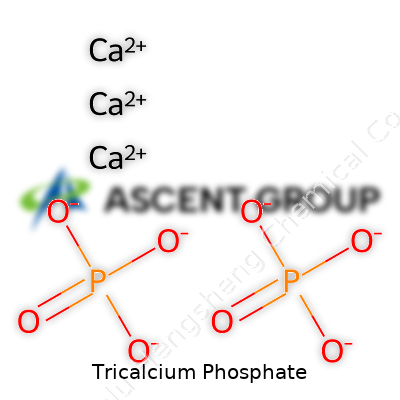
Tricalcium phosphate’s roots stretch back to fields and laboratories in the nineteenth century, where early chemists discovered its significance in bones and animal tissues. From an industrial perspective, the rush to provide calcium supplements for agriculture and food fortification fueled much of the early innovation. My own plant’s early history holds stories about engineers improvising reactors with limited temperature control, recognizing tricalcium phosphate’s value for plants and people before textbooks started listing it. The investment in better filtration, purification, and drying infrastructure laid a foundation for today's volume and consistency, and every improvement followed demands in food safety, agriculture, and bio-compatibility. Product consistency often traced back to these decades of practical trial and error, more than any textbook declaration.
Tricalcium phosphate doesn’t try to play every role in the chemical world, but it holds exceptional importance in areas where bioavailability and safety walk hand in hand. In my experience, production shifts focus on batch integrity above all else—each run, teams measure calcium and phosphate ratios to ensure the white powder meets quality benchmarks. Its key applications come in three forms: direct food additives, nutritional supplements, and as a base for synthetic bone or ceramic applications. End users inspect the material with the same rigor that we use at the source, since any deviation brings scrutiny from regulators and buyers alike. Reliability drives repeat orders and allows users in food, pharmaceuticals, and agriculture to trust it for fortification and formulation.
Tricalcium phosphate often appears as an odorless, tasteless white powder under proper storage. Its low solubility in water sets the stage for slow calcium release—a crucial property for agriculture and food formulation. Chemically, we’re dealing with the formula Ca3(PO4)2, which sets calcium content at about 38 to 40 percent by weight. Quality control departments lean on spectroscopic checks and gravimetric assays to confirm this, with X-ray diffraction and moisture analysis picking up any anomalies. The low moisture absorption helps to extend shelf stability, but humidity controls in warehouses still play a big role in maintaining flowability and preventing caking.
Every customer brings technical sheets to the discussion, but in production, real-world factors push us to pay attention beyond numbers. Specifications usually reference purity thresholds, typically above 95%, with limits on heavy metals and fluoride content set by authorities like the US Pharmacopeia or EU food codices. Labels stretch across multiple languages and regulatory frameworks, tying finished products to detailed certificates of analysis. From an operator’s standpoint, paperwork must align with what stands in totes and drums onsite. Over the years, mismatches between labels and batch records have always flagged further investigation, reinforcing the need for policed traceability through manufacture, storage, and delivery.
Commercial batches often use mineral-derived calcium sources, usually limestone, blended with phosphoric acid. The main reaction occurs under carefully controlled pH and temperature. Filtering out calcium phosphate from the mix, followed by thorough washing and drying, leaves the final powder. Early output at my plant relied on batch reactors; today, continuous flow equipment ensures more precise dosing and temperature control, reducing energy use and waste. Technicians track impurities, as small deviations in acid concentration or water quality can throw off yields and cause excess phosphate or calcium to contaminate finished lots. By-product management, especially from acid neutralization, keeps our environmental team busy ensuring nothing leaves the plant the wrong way.
Beyond straightforward precipitation, tricalcium phosphate reacts with mineral acids to generate soluble salts—a feature producers and researchers both exploit to tweak solubility or adapt the material for specific bioceramic uses. At higher temperatures, this raw form transitions to other calcium phosphates, such as hydroxyapatite, important for biomaterials. Sometimes, custom blends involve doping with magnesium or trace metals to enhance bio-compatibility for bone grafts. Production lines adapt through direct blending or by altering the precipitation environment, responding to custom specs where science meets logistics. Small changes in pH, temperature, or reagent order lead to notable shifts in finished particle size and reactivity.
Whether buyers call it tricalcium phosphate, TCP, tribasic calcium phosphate, or by E-number E341(iii), all these names circle the same core composition. Specialty grades carry proprietary trade names, particularly in the ceramics and bone regeneration markets, but these rarely stray far from standard chemical identifiers. For bulk commodities, both international and regional regulatory language can trip up shipments if not clearly documented during customs clearance. On the plant floor, every bag—regardless of what’s stenciled in big letters—gets tagged with internal and regulatory IDs to prevent mix-ups between similar powders.
Real-world manufacturing pays constant attention to worker safety and product stewardship. Dust control gets priority because airborne fine powders create respiratory risks and complicate cleanup. We follow strict rules on personal protective equipment, and our experience shows that open handling steps—silo transfers, bagging, or line cleanouts—demand regular air-quality monitoring. Environmental agencies track our effluent and emissions closely. Food and pharma grades set a higher bar for trace contaminants, with regular audits looking for traces of heavy metals, fluoride, and microbials. Onsite teams document every batch, with digital logs and physical sampling, because even minor lapses can harm people and undermine the credibility that took years to build.
Once tricalcium phosphate leaves the plant, it joins a surprising range of end users. Food processors blend it into baked goods, dairy, infant formula, and powdered beverages for both calcium content and flow control. In agriculture, it enriches feed and soil, improving crop and livestock output. Medical device companies use specialized grades to support dental and orthopedic reconstruction, sometimes using our powder as a raw ingredient for 3D-printed scaffolds that foster bone regrowth. Ceramic and glass producers turn to it for its high-temperature properties. Through these channels, the product reaches infants, patients, and animals, putting the weight of public confidence on every truck that heads out our gates.
Even after decades of production, laboratories keep pushing the boundaries of purity, particle size, and functionalization. With customer feedback, we refine micronization or surface treatment, aiming at better dispersibility or tailored dissolution rates. R&D teams invest time and money in predictive modeling, waste minimization, and hybrid materials combining tricalcium phosphate with polymers or proteins. Bioceramics receive particular attention; advances here often rest on small tweaks in precursor chemistry or processing temperature, giving surgeons and dentists improved options. Keeping pace with regulatory changes means R&D needs to anticipate new safety limits or permissible limits for impurities, and stay ready for new application frontiers.
As a calcium source, tricalcium phosphate generally benefits from a strong safety record. Toxicological data confirm its lack of acute health impacts at nutrition-relevant dosages, but ongoing studies target bioavailability, heavy metal uptake, and chronic exposure risks. Each new batch gets reviewed for contaminants, especially as public attention scrutinizes ingredients in infant nutrition and supplements. Our technical team reviews animal and cell studies, watching for emerging findings on absorption, excretion, and interactions with gut flora. Regulatory frameworks evolve, and researchers keep all actors honest as expectations for food-grade phospates or biocompatible ceramics rise.
Looking ahead, tricalcium phosphate sits at the intersection of food security, nutritional policy, and biomedical innovation. My sense from the plant floor and research bench alike is clear: manufacturers able to balance purity, cost, and sustainable sourcing do better in this changing landscape. As agricultural demands shift with population and supply chain pressures, technical teams pivot toward optimizing process yields, resource efficiency, and recycling. Biomedicine and 3D printing open new avenues, with custom material blends needed for patient-specific implants. Ongoing engagement with research partners and regulators helps us anticipate new regulations, proving that technical adaptability, safety culture, and process transparency set apart reliable suppliers from the rest.
Walking through a food plant, pharmacy, or fertilizer line, I notice our tricalcium phosphate turning up all over the place. It’s a basic mineral, but it pulls a lot of weight. Most people running a bakery or nutritional supplement business stop recognizing it after reading the back of the packaging, but for us, the folks making the powder and shipping the bags, the significance goes deeper. Each granule represents quality control, process know-how, and a practical answer to old problems. In our daily work, we see where tricalcium phosphate really makes a difference.
One of the earliest and most dependable roles for tricalcium phosphate comes from the food industry. Bakers and food technologists turn to us for this compound mainly to prevent caking and to keep powders flowing. Think pancake mixes, spice blends, or non-dairy creamers. Without it, powders stick or harden, and dosing machines jam. We monitor our process for purity and consistent particle size, hearing often from customers who rely on predictable behavior. Every batch means less downtime for them and fewer production headaches. Providing consistent quality keeps their operations running smoothly—and that goes straight to their margins.
We receive repeat orders from companies fortifying foods with calcium and phosphorus. Both minerals support bone health, and when tricalcium phosphate lands in breakfast cereal or a sports bar, it boosts the nutritional value without strange aftertastes. Calcium carbonate lines the shelves, but tricalcium phosphate offers a choice for formulators who want a measured phosphorus source as well. We avoid contamination by following food safety standards, since our material goes right into what people eat every day. It matters to us that our production decisions ripple out to real health outcomes.
Pharmacies and supplement brands rely on tricalcium phosphate as a tablet excipient. They can compress powders into hard, uniform tablets without running into flow problems. Our teams invest in equipment that produces controlled granule sizes and keeps impurities away. We know that one batch fails and it doesn’t just affect us—downstream delays add up fast for our customers. Along with tablets, dental suppliers turn to our product as a base for some toothpaste and enamel repair technologies. These demand high purity and precise physical properties. Batch records, audits, and certifications are part and parcel of our routine just so practitioners can trust what gets placed in a patient’s mouth.
Agricultural producers use tricalcium phosphate to help balance calcium and phosphorus in animal feed. Without proper mineral levels, farm yields drop and animal health declines. We get feedback from farmers about how our material dissolves or mixes, sometimes making tweaks to meet their needs. Our technical support is not just a call center menu—we talk with those actually feeding livestock. Producing a stable, dust-free, and readily available mineral makes a real impact on livelihoods, not just line items on sales sheets.
Making tricalcium phosphate isn’t just about chemistry. We invest in modern scrubbers and closed loops, reducing environmental load and making sure nothing leaves the plant unchecked. Inspections from food and pharmaceutical regulators push us to improve. We adjust processes, retrain teams, and watch regulatory updates closely. Our pride grows from knowing the product isn’t simply moving through warehouses, but helping diets, medicines, and farms. A seemingly simple powder links us to families, athletes, animals, and entire communities.
Tricalcium phosphate, or TCP, stands out in hundreds of technical conversations each month inside our plant. That’s not just because of its wide reach through the food and nutrition industries, but because its safety often gets questioned by people far removed from the realities of its manufacture. Years of daily hands-on work with TCP have shaped how we view its place in the food supply. This isn’t about abstract theory from a distant lab — it’s what you notice up close, batch after batch.
TCP comes from a direct, straightforward process. We take calcium carbonate and phosphoric acid to combine them under carefully watched temperatures, then filter, dry, and grind the resulting crystals. Every step gets checked; there’s nothing mysterious about how it gets into food. That transparency matters — anyone interested can trace the journey from raw input to finished powder.
The question that always comes back — is TCP safe to eat? Food safety agencies that set global and regional standards—such as the FDA and EFSA—have given tricalcium phosphate the all-clear for food uses. They look to toxicology studies, real-world dietary surveys, and careful laboratory analysis. Their consensus: it doesn’t build up in the body, and it gets excreted much like other calcium compounds. Used at the levels permitted, it doesn’t pose any hidden danger. We echo this, since every batch we ship works within those limits.
Some people worry about phosphates in the diet, worried that too much could throw off the body’s mineral balance. Problems can happen, mainly for people with serious kidney trouble. For everyone else, the small amounts found in fortified baking mixes or breakfast cereals aren’t going to tip the scales. Our technical teams keep strict control over calcium and phosphorous ratios in every blend, reflecting safety margins established far beyond our own plant floor.
Gritty rumors about heavy metals sometimes float around discussions of phosphate foods. Here, we don’t just take supplier word for it: ICP-MS tests run daily in our on-site lab. Whether it’s arsenic, cadmium, or lead, every lot must meet food-grade limits far tighter than thresholds set for industrial grades. This rigorous process weeds out lots that fail to pass muster. The finished powder that leaves our doors can safely head into baby formula, dairy mixes, and mineral supplements.
People often ask whether tricalcium phosphate is ‘natural’ enough. We can show exactly how it’s made and put every statistic and certification stamp on the table. What counts, to us, is whether its safety and reliability hold up after years of scrutiny. After all, the equipment in our plant can’t afford guesswork or shortcuts. The responsibility we carry is to feed honest answers back to anyone who asks—small towns, big food companies, or the farmers who rely on clean animal feeds.
No manufacturer worth its salt takes food safety questions lightly. TCP’s record in food speaks for itself through decades of safe use and thousands of tested lots. As process engineers and chemists who work with this material every day, our advice is simple: trust the track record, check your facts, and never stop pushing for higher standards in every drum, bag, and spoonful.
As a manufacturer that produces tricalcium phosphate day in and day out, we understand more than just the chemistry. This compound shows up across food processing, pharmaceuticals, nutritional supplements, and even ceramics. We have watched regulators examine its safety, end users debate its benefits, and researchers roll out new studies year after year. Still, one question comes up often: What side effects come with tricalcium phosphate?
Most stories about side effects point toward the digestive system. Some users of calcium phosphate report mild gastrointestinal symptoms. You might hear about bloating, flatulence, or constipation, especially if someone takes high doses as a calcium supplement. Large amounts of supplemental calcium of any kind can slow down bowel movements. From our experience, these issues don’t arise from the trace amounts in food products or tablets taken as recommended.
Adverse reactions seem to appear only with excessive supplementation or in people with highly sensitive digestive systems. The U.S. FDA categorizes tricalcium phosphate as ‘generally recognized as safe’ (GRAS) for most applications. This status didn’t come by accident; regulators reviewed available data on toxicity and real-world usage over decades.
Tricalcium phosphate gives both calcium and phosphorus to the body. Both play vital roles in bone metabolism. The trouble can start if someone already takes a lot of phosphorus or uses other high-calcium products. Our technical staff sees this in customer inquiries. Too much calcium may increase the risk for kidney stones, while too much phosphate changes how the body uses other minerals.
We keep the ratio balanced in our products, aiming for a level that fits dietary guidelines. Data from nutritional studies suggest few people face problems when tricalcium phosphate is only one source of these minerals. People with chronic kidney disease or certain hormone disorders may need stricter control, but average, healthy consumers rarely see side effects at normal intake levels.
Some customers ask if exposure to tricalcium phosphate could result in allergic reactions. Our records over decades show very few genuine allergy reports. If a reaction occurs, it’s usually tied to dust inhalation in bulk handling—think operators or line workers, not end consumers. This can cause mild irritation in the eyes, nose, or throat. Industry-standard PPE addresses the risk. In finished consumer products, tricalcium phosphate does not act as a common allergen.
Problems sometimes come not from the chemical itself but from unknown contaminants. As a manufacturer, we source globally certified raw materials, and batch test every lot for heavy metals and other impurities. Our clients demand these controls. If tricalcium phosphate comes from unregulated sources, anything from excess lead to stray silicon can sneak in—this is where real risk comes in. Purity assurance eliminates most side effect concerns in reputable supply chains, while subpar products raise the stakes for everyone.
Tricalcium phosphate isn’t a new player. Its human safety profile has held up to scrutiny, but as food manufacturers add more mineral enrichments to packaged goods, ongoing evaluation matters. Clear labeling, transparent sourcing, and continued research will help the industry answer new questions and avoid unexpected side effects. Our commitment lies in building quality into the material—all the way from raw input to finished product.
A question pops up often: Is tricalcium phosphate just a fancy name for calcium phosphate, or is there a real difference? On a basic level, all tricalcium phosphate falls under the wider family of calcium phosphates, but chemistry doesn’t leave much room for shortcuts. The differences matter—a lot—when it comes to performance on the production floor and the outcome for end users.
‘Calcium phosphate’ covers a whole group of compounds, including monocalcium phosphate, dicalcium phosphate, and tricalcium phosphate. Each compound carries its own ratio of calcium to phosphorus, its own level of solubility, and a distinct set of attributes that determine where it fits best. In our plant, batch control and traceability depend on knowing precisely which phosphate we’re using, and that isn’t just paperwork. Mixing them up can throw off formulations, react unpredictably, or even violate regulatory standards.
Tricalcium phosphate, or TCP, has three calcium atoms for every two phosphate groups. Simple enough, but this balance gives TCP its well-known role as a calcium booster and anticaking agent. Applications in food, pharmaceuticals, and feed rely not just on its calcium yield, but also on its low solubility and neutral taste. These properties set it apart from others. The differences don’t end in the lab. Trying to replace TCP with dicalcium phosphate (DCP) or monocalcium phosphate (MCP) in a formulation that’s been designed for TCP often delivers subpar performance. In the worst case, batches must be scrapped.
Formulators in the food and pharmaceutical industries keep a close eye on which type of calcium phosphate they use. Regulatory standards lay out clear boundaries for each type, right down to the molecular structure. Even the health benefits differ. TCP offers higher elemental calcium than its cousins, which shapes how products get labeled and marketed. Anyone working with omega-3 encapsulation, food fortification, or tableting has seen the difference firsthand.
Substituting one form for another can cause downstream effects, from tablet hardness in supplements to the texture of powder blends in beverages. Purity and particle size drive performance, but so does the chemical structure. We spend much of our time calibrating milling, drying, and blending steps to maintain these quality standards batch after batch.
Requests occasionally land on our desk asking for “calcium phosphate,” with no further details. The only smart move is to pick up the phone, clarify, and steer the conversation back to chemical specifics. Manufacturing teams, nutritionists, and purchasing agents know their project can succeed or fail based on this single detail.
Mistakes can be costly. If a supplement label claims it contains TCP but actually includes MCP, penalties and recalls may follow. In the fertilizer sector, using the wrong phosphate type may reduce crop yield or soil compatibility. As a manufacturer, the job isn’t just making the product; it’s making sure every order is fit for purpose, right down to the compound’s crystalline structure.
Years of hands-on production teach a simple lesson: shortcuts don’t pay off. Matching the right type of calcium phosphate to the right use means investing in precise chemistry, ongoing staff training, and strong supplier relationships. This approach not only maintains compliance and customer trust but keeps us competitive in a market that demands nothing less than accuracy.
As a chemical manufacturer, years of hands-on work with tricalcium phosphate in the plant provides a front-row seat to both its strengths and limits. Every batch starts with raw calcium sources and phosphorus minerals, processed deliberately to produce the white, tasteless powder recognized across scores of industries. Tricalcium phosphate gets blended into foods, medicines, and nutritional products, so we have witnessed its real-world impacts and pitfalls across these settings.
In food manufacturing, tricalcium phosphate often works as a trusted additive. Companies that produce breakfast cereals, plant-based milk, and even candy rely on it to boost calcium content and prevent caking. It mixes easily and keeps physical stability, which helps brands deliver consistent nutrition without fuss. Many communities worldwide have benefited from these applications, particularly in regions where dietary calcium falls short of health targets.
The supplement market has always chased the most efficient form of calcium. We’ve pressed tricalcium phosphate into tablets and added it to meal replacement blends for decades. Yet, not all calcium sources support body absorption equally. Multiple clinical studies and health authorities point out that tricalcium phosphate’s actual absorption rate in the gut comes in lower than more soluble sources like calcium citrate or calcium carbonate. In water, tricalcium phosphate barely dissolves, so the body only takes up part of what enters the stomach.
This reduced solubility means some populations—like older adults or folks with digestive challenges—may not benefit much from tricalcium phosphate as their main calcium source. Food scientists and nutritionists often prefer citrate or carbonate forms for people with greater clinical need, using phosphate-based compounds to round out minor deficiencies or stabilize formulas when taste and texture matter most.
Most regulatory agencies, including major food and health authorities, permit tricalcium phosphate’s use in both foods and supplements when manufacturing and usage comply with strict purity standards. Our production facilities invest heavily in traceability and contaminant controls, as safety questions don’t take days off. Intake limits reflect the need to avoid excess phosphate, especially for people with chronic kidney issues.
Years of manufacturing scrutiny and post-market surveillance reveal that healthy consumers experience no widespread adverse effects from tricalcium phosphate as an ingredient. Any safety risk rises in people with certain medical conditions or in cases of heavy overconsumption, which is why dose guidance always matters.
For manufacturers, continued collaboration with nutrition scientists drives improvement. Advances in particle technology and micromilling have helped fine-tune tricalcium phosphate’s dispersion and mouthfeel in finished goods. On the supplement side, some formulators combine low-solubility calcium sources with higher-solubility types, aiming to boost absorption rates while maintaining formula stability. Transparent labeling and clear education remain a manufacturer’s basic responsibility.
Simple communication matters most. Some people will benefit from tricalcium phosphate as a minor calcium boost; others should seek alternatives better suited to their individual needs. The job of a calcium ingredient producer includes helping both manufacturers and consumers make informed, safe choices for their health goals. Our work doesn’t end when a batch leaves the plant—it continues with each new study, each feedback call, and every regulatory update in the market.